Showing posts with label multiplication. Show all posts

Monday, May 2, 2016

Connecting Math and Art to Teach Multiplication

In October of 2011, one of my students, now a highly successful classroom teacher, created an annotated bibliography on connecting math and art in the teaching of multiplication. I've updated that information and included a number of new resources. My thanks to Christine Mingus for the original post.
*****

In the interest of finding new and artful ways to help teach children about multiplication, this post highlights resources that use art to enhance math instruction, increase student motivation and engagement, and help students tap into fun and creative ways to think about math concepts.

Visual learners, and even ELL students, benefit from making projects that allow them to explore mathematical concepts in new ways -- and art is all about looking at the world from multiple perspectives.  Art simply feels like play for elementary aged students, and using it to explore multiples and place value helps foster their confidence in their math abilities and definitely works to keep a multiplication lesson percolating.  Many children see art as a non-threatening subject matter, and using it to ground a lesson is a great way to generate ideas and excitement among your young mathematicians.  Getting them to see the visual and creative aspects of math can go a long way in teaching the algorithms of multiplication and can create a lot of math-positive, math-rich dialog in the process.

In third grade, students begin to explore basic multiplication by utilizing strategies, algorithms, and appropriate methods of computation.  As they progress beyond simpler whole number operations into this new realm of mathematical thinking (learning the multiplication tables through the twelves), art can lead the way and ease the transition into higher level reasoning and problem-solving.

Web Resources
Artful Connections With Math: Multiplication Array Prints -  In this lesson, students explore positive and negative space and create a stamp on top of a watercolor wash. They repeatedly print the stamp as an array representing a fact family of multiplication and division number sentences. The video below provides additional information about this lesson.

Multiplication City Art - See how one teachers helps her students learn array multiplication by creating city blocks where the buildings are created by differing arrays of windows.

Art Inspired Math - This brief article by Michael Naylor describes some activities that will get students looking for mathematics in artwork and also creating their own artwork to show off geometric ideas.

Fooling Around With Math and Art - Here's a description of an interesting art project that morphed into a cool way to look at array multiplication.

Origami Multiplication Flash Cards - If cootie catchers aren't your thing, you may want to make these basic origami shapes and encourage your students to do the same.  These are found on Rick Morris's New Management website, and you can use them with his multiplication triangle tests (downloadable as a PDF file at the bottom). 

Math Art: Hands-On Math Activities for Grades 2, 3, and 4 - This is the web page that accompanies Zachary Brewer's book (see below).  Here you will find pictures and descriptions of various projects throughout the book, including his lesson on common multiples and his lesson on multiplication arrays.

String Art and Math:  A Project in Multiplication - While I normally associate string art with bad 1970s home decor, I think this is a really interesting way to play artfully with multiplication.  Instead of using nails to create the string art, students will have to be advanced enough to know how to use embroidery thread and needles to pull the thread through cardstock printed with the design template.  This could be a good art/math center activity for those students with strong fine motor skills, and could produce very colorful work for display in the classroom.  (The sample worksheet is downloadable as a PDF file at the bottom of the page.)

National Gallery of Art:  NGA Kids - While this is just a wonderful arts site for kids to create their own artistic compositions, you can bookmark this at your classroom computer center and invite students to create online works that demonstrate multiplication concepts.  Basic multiplication can be expressed through art through image repetition, and here kids can try all kinds of cool programs: BRUSHTER (an interactive painting machine); NGAkids Photo Op (an introduction to digital photography and image editing); the Collage Machine; Mobile Maker; FLOW (a remarkable interactive motion painting program); and Wallovers (which uses a 6 x 4 grid for students to create symmetrical compositions and can reinforce the interrelatedness between multiplication and addition).  Students can create the multiplication masterpieces and then write out what kinds of images are multiplied in their work (and express them as equations).  

Books for Teachers

Mathematical ART-O-Facts: Activities to Introduce, Reinforce, or Asses Geometry & Measurement Skills by Catherine Johns Kuhns. (2008). Crystal Springs Books (978-1934026113). Gr. 3-6.

This book contains 22 different math activities focused on geometry and measurement, though multiplication and division concepts can be found woven throughout the lessons. Fun and engaging, all of these activities promote mathematical thinking and creativity through problem solving.


Math Art:  Hands-On Math Activities for Grades 2, 3, and 4 by Zachary J. Brewer.  (2010).  Create Space (1453636439).  Gr. 2 - 4.

This book shows you how to successfully integrate arts into any elementary math curriculum. Each of the math activities ultimately result in an aesthetically-pleasing project that reinforces a basic math concept.  Inside are two great projects to help teach multiplication to third grade students:  a project about multiples (p. 14 - 17), which demonstrates how to skip count and how to tell the difference between common and uncommon multiples, and another that shows how to represent multiplication facts as arrays (p. 26 - 27).  All the lessons list teaching objectives, what materials are required, full project descriptions, and black line masters of reproducible assessment sheets (which require students to explain their mathematical thinking in writing).
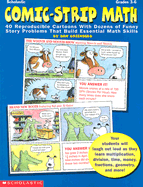
Comic-Strip Math:  Problem Solving: 80 Reproducible Cartoons with Dozens and Dozens of Story Problems That Motivate Students and Build Essential Math Skills by Dan Greenberg.  (2010).  Scholastic Teaching Resources (0545195713).  Gr. 3-6.

This is such a brilliant idea - what a fantastic way to blend art, math, reading,and writing.  Using comics to explore math encourages students to use their visual, verbal, spatial, and logic skills in interpreting situations.  While most of the multiplication exercises in the book incorporate multi-step problems (some of which also ask children to take the next step into division), there is a nice section in the book with lots of fun activities for them to solve (p. 12 - 19).  Each lesson features a comic at the top, which concludes with a "figure it out" question, and then the follow-up questions listed below take on a more-familiar worksheet format.  There are "super challenges" at the bottom of each page to help students extend what they've learned and some encourage them to create their own pictures, diagrams, charts and models.  Consider setting up a math/art center for students to make their own multiplication comic strips. You could use graph paper to help them better design the more traditional story-board layout, or take larger paper and fold it to create frames for students to draw in. Encouraging them to think about and ask multiplication problems through art and humor and then asking them to share them with classmates could be incredibly fun for everyone.
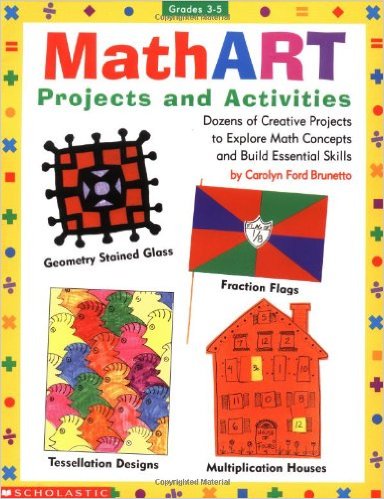
MathART Projects and Activities by Carolyn Ford Brunetto.  (1999).  Scholastic Teaching Resources (0590963716).  Gr. 3 - 5.

This book is full of good ways to connect math to simple art projects, and inside there are two very fun multiplication projects:  multiplication constellations (p. 38 -41), and my favorite idea, multiplication houses to reinforce basic multiplication facts for numbers 1 to 12 (p. 40 - 41).  Using the template, students can create their houses - or if you are more artistically inclined, you can encourage them to create their own houses (or skyscrapers, or other buildings).  For example, if a student creates the house of nine, the number 9 would be written on the door. The numbers 1 to 12 would be written on the house's twelve windows. When you open the window to any given number, you see the product of nine and that number revealed.  Creating these houses for kids to use as lesson guides would be very enjoyable, and if you made large ones for your classroom, you could create your own Multiplication Neighborhood that your students could look at for review.  

Quick and Easy Math Art:  Dozens of Engaging Art Activities That Build and Reinforce Essential Math Skills and Concepts by Deborah Schecter. (2011). Scholastic Teaching Resources (0439199425).  Gr. 2 - 4.  

Here is another great art-math resource offered by Scholastic, chock full of great, inexpensive, and simple projects that anyone can do.  There are a number of very cute multiplication activities (p. 14 - 22):  Be Mine! Multiplication (which you can see in color on the cover of the book), Multiplication Menageries, Fall Factor Trees, and Teeny-Tiny Times Table Books.  The author makes it clear that educators should test out these projects before introducing them to the class - as any art teacher can tell you, figuring out how to do them on your own first can help you determine exactly how you need to model instruction, what steps are important to emphasize, and will help you figure out how complicated (and possibly time consuming) it is going to be.  Many of these multiplication projects would be suitable to use at math centers. 

Monday, October 21, 2013

Monday Math Freebie - Dots and Boxes Games

Classroom Freebies Manic Monday
While searching for resources for teaching scientific notation I came across a middle school version of the dot game where students were required to simplify exponents and record numbers in scientific notation. I loved this idea and wrote to the author asking if I could adapt his idea for the elementary classroom. My thanks to Kevin Koch for giving me permission to create these resources!

In this version of the dot game, students draw line segments and form boxes as usual. When they complete a box, they earn one point. However, if they complete a box with a number sentence, they must say the number sentence aloud and give the solution. Answering correctly earns a player extra points. Once all the boxes have been made, players total their scores. The player with the highest score is the winner.

The two versions I have today are for practicing basic facts, one in addition and one in multiplication. Here's what they look like.


I hope you get a chance to use these in your home or classroom. Please let me know if you try these and how you like them! 

Monday, October 14, 2013

Monday Math Freebie - Fall Themed Multiplication Games

Classroom Freebies Manic Monday
In honor of fall I have created two new multiplication games and "dressed up" some old game boards for practicing basic facts in multiplication.

Here's what you'll find in this packet.


I hope you get a chance to use these games in your home or classroom. Please let me know if you try them and how they work! 

Monday, April 8, 2013

Monday Math Freebie - Three to Win!

Classroom Freebies Manic Monday
Three to Win is a simple, quick game where students practice basic facts in addition, subtraction and multiplication while using problem solving strategies. The first player rolls two dice and says the numbers. Then he/she looks at the empty spaces on the board and decides whether to ADD the numbers, SUBTRACT the numbers, or MULTIPLY the numbers. Once a choice is made, the player says the number sentence aloud and places his/her marker over the answer. If a player rolls doubles, he/she must cover one of the images on the board. Play alternates until one player gets three markers in a row, vertically, horizontally or diagonally.

There are several different versions available in this packet. They are pictured below.

 Download Three to Win.

I hope you get a chance to use these in your home or classroom. Please let me know if you try these and how they work! 

Saturday, March 30, 2013

Math Freebie - Moo-ve It Games (+/x)

Here are two different adaptations of a game I found several years ago on the NC DPI web site

Version 1: Moo-ve It Addition! - In this game players roll two dice, determine the sum, and cover one occurrence of the sum on the game board. Players can bump each other's markers off the board to make room for their own. The first player to get three markers in a row is the winner.

Version 2: Moo-ve It Multiplication! - In this game players roll two dice, determine the product, and cover one occurrence of the product on the game board. Players can bump each other's markers off the board to make room for their own. The first player to get three markers in a row is the winner.

I hope you get a chance to use these in your home or classroom. Please let me know if you try them and how they work! 

Monday, March 11, 2013

Monday Math Freebie - Multiplication BUMP!

Classroom Freebies Manic Monday
My class has just finished multiplication and division. Here's a set of BUMP boards I made to practice basic facts. You'll find boards for facts from 1-12. Students roll a 10-sided die and then multiply by the factor on the board.
There are two versions available. They are both pictured below.


If you don't have 10-sided dice, you can download a really nice set of dice templates from the Twinkl web site. Please note that you must sign up for a free account to download.

If you prefer to use spinners instead of dice, here is a set of 1-10 number spinners. In this file you'll find one large spinner, two medium-sized spinners, and four small spinners.
Download 1-10 Spinners.

I hope you get a chance to use these in your home or classroom. Please let me know if you try these and how they work! 

Monday, March 4, 2013

Monday Math Freebie - Function Machine Fun

Classroom Freebies Manic Monday
I've been trying to find a fun way to practice basic facts while working with patterns and function machines. I think this idea works well.  Player 1 draws a Function/Rule card and hands his/her partner the number cards that correspond to the input numbers. Player 2 selects one of the input numbers and places it on the inbox of the function machine mat. Player 1 reads the rule on the Function/Rule card and places the correct output number on the outbox of the function machine mat. Player 2 records the information on an Input-Output Chart and tries to determine the rule. Play continues in this fashion until the rule is determined or the player runs out of recording spaces. After each player has taken four turns guessing the rule, players total their scores (total number of guesses needs) and the lowest score wins.

Here are a few sample images.


I hope you get a chance to use this in your home or classroom. Please let me know if you try it and how it works! 

Friday, December 7, 2012

Math Freebie - Steal the Treasure (X Version)

While I was recreating an addition game I first saw in a fabulous post by Aimee of Primarily Speaking, I decided a multiplication version was needed.

Here's a snapshot of the multiplication version of Steal the Treasure.


The game comes with teacher directions, student directions (shown), and a game board. 

Download the multiplication version of Steal the Treasure!. Please let me know if you try this with your students and how they liked it.

Thursday, October 4, 2012

Domino Math - Addition and Multiplication

I've been working with my class on the operations of addition and subtraction. I like to use dominoes to practice basic facts, so I've been exploring different ways to do this. Here's a form I created for students to sort dominoes and then record corresponding addition sentences.
Download Domino Addition Sort.

In anticipation of where I'm going with my class, I went ahead and created a similar page for multiplication.
Download Domino Multiplication Sort.

If you download, please let me know what you think. Enjoy!

Thursday, June 14, 2012

Introduction to Multiplication

My summer class is already half over and we've just begun to think about teaching multiplication and division. Here's the introductory activity I gave them to think about repeated addition, making arrays, and writing number sentences.

This activity meets the following Common Core Standards for Mathematics.
  • 2.OA.4 - Work with equal groups of objects to gain foundations for multiplication. Use addition to find the total number of objects arranged in rectangular arrays with up to 5 rows and up to 5 columns; write an equation to express the total as a sum of equal addends.
  • 3.OA.1 - Represent and solve problems involving multiplication and division. Interpret products of whole numbers, e.g., interpret 5 × 7 as the total number of objects in 5 groups of 7 objects each. For example, describe a context in which a total number of objects can be expressed as 5 × 7.
Download Building Sets.

Wednesday, February 22, 2012

Multiplication Game

I've been spending time recently pinning teaching materials to my Pinterest site. I currently have 36 boards, the bulk of them for math. I've been sharing some of the great ideas I find in my classes with my preservice teachers. Last night they asked the question, "How do teachers make all these great things?" I'll admit that I'm pretty savvy with Word, but I don't have the skills that many of these teachers have!

I did promise my students I'd experiment a little, so here's my first, very simple effort. When students got this file in class last night, it looked like this.

This morning after I "prettied it up," it looked like this.

Feel free to download Multiplication Four-in-a-Row. If you want to use this in the classroom, I recommend laminating and putting in a center. You could also send this home as a "Math in a Bag" activity. This kind of homework is great fun!

If you try this, please leave me a note and let me know what you think. If the feedback is good, I will work on uploading some additional resources.

Monday, November 14, 2011

Annotated Bib - Multiplication

Multiplication is an important skill for students to learn. Mastering basic facts is essential and can be difficult for some students. Here are some resources to introduce the concept of multiplication and help students practice basic facts.

Books:


2x2=Boo: A Set of Spooky Multiplication Stories. By Loreen Leedy. 1996. 32 pages. illus. Holiday House Publishers (9780823412723). Gr 3-4.
This book uses creepy creatures like vampires and witches to explain multiplication tales. The “characters” are used in examples to count up, and in some cases down (in multiplying zeros). It only concentrates on numbers 0-5, so it should be used in the beginning multiplication lessons, or for remediation or inclusion classes.


All Aboard Math Reader Station Stop 3 Breakfast at Danny's Diner: A Book About Multiplication. By Judith Stamper. 2003. 48 pgs. illus. Grosset & Dunlap (9780448432106). Gr. K-3.
This books says for ages 4-8, but the reader must have mastered multiplication to understand it; or at least have a good concept of it. I like how the book uses real life examples of math in a diner to make multiplication relevant to the reader.


The Amazing Pop-Up Multiplication Book. By Kate Petty. 1998. 16 pgs. illus. Dutton Juvenile (9780525459989). Gr K-3.
So what kid doesn’t love a pop-up book? It may not be the longest or review all of the facts, or be an involved story behind it, but there is something to be said in a book that engages the children and makes them want to read it!


Corkscrew Counts: A Story About Multiplication. By Donna Jo Napoli and Richard Tchen. 2008. 32 pgs. illus. Henry Holt and Co. (9780805076646). Gr K-3.
Another book directed at younger ages but using the multiplication theories as background. But, the story is centered around a party and how many different ways they can mix up the number of people to play games. So, it looks at fact families as well.


Pigs Go to Market: Halloween Fun with Math and Shopping (Pigs Will Be Pigs). By: Amy Axelrod. 1997. 40 pgs. illus. Simon & Schuster Books for Young Readers (9780689810695). Gr 2-4.
This story is uses multiplication and a variety of math skills to compute what candy has been already eaten, and what they will need for the number of guests attending a Halloween party. It is a fun, seasonal book with pictures and multiplication equations.


Websites:


This is a good refresher site or for students that need a visual on multiplication. It has pictures and different colors to reference which pieces are being counted or multiplied.

I found this website and it reminded me of the activity we did in class. You plug numbers to multiply (up to 12), and the columns/row highlight. It shows the two ways to get the answer; by going to the row first and down the column, or the opposite. It can reinforce the fact family activity we did with crayons.

If the website above it too challenging for a student, this may suite them more. At the start of the game, the student has 16 tiles of numbers. A math problem shows in bottom left corner, and the student clicks on the correct answer and the tile disappears. Repeat until all problems are answered and all answers are gone. It gives the correct answer if incorrectly chosen and allows the student to repeat the problem later in the game to ensure understanding.

Here’s a timed 30-second game of single or double digit multiplication. While I wouldn’t use this for my struggling math students, it’s a good site to use for the advanced ones; something to use to differentiate a lesson. The clock starts counting at the first ‘card’ and will display the number correct at the end. The problems shuffle upon reload.

A math teacher created this page to give other teachers resources for multiplication & SMARTBoards. Gives the teacher a little more interactive way to teach this subject in a whole group setting. Could be used as a starter lesson before breaking into smaller groups.

For Teachers
Virginia Standards of Learning
3.5 The student will recall multiplication facts through the twelves table, and the corresponding division facts.

Background Information from the Curriculum Framework

  • The development of computational fluency relies on quick access to number facts.
  • A certain amount of practice is necessary to develop fluency with computational strategies; however, the practice must be motivating and systematic if students are to develop fluency in computation, whether mental, with manipulative materials, or with paper and pencil.
  • Strategies to learn the multiplication facts through the twelves table include an understanding of multiples/skip counting, properties of zero and one as factors, pattern of nines, commutative property, and related facts.
  • In order to develop and use strategies to learn the multiplication facts through the twelves table, students should use concrete materials, hundred chart, and mental mathematics.
  • To extend the understanding of multiplication, three models may be used:
    • The equal-sets or equal-groups model lends itself to sorting a variety of concrete objects into equal groups and reinforces repeated addition or skip counting.
    • The array model, consisting of rows and columns (e.g., 3 rows of 4 columns for a 3-by-4 array) helps build the commutative property.
    • The length model (e.g., a number line) also reinforces repeated addition or skip counting.

Monday, October 24, 2011

Annotated Bib - Multiplication

Multiplication enhances students knowledge of number sense and helps them move through problems by using a quicker method then just repeated addition. Students first see multiplication when they begin skip counting and carry it through in their multiplication charts and memorization of facts. The books listed here would work best for grades 3-4.

Books
The Best of Times by Greg Tang. Illus. by Harry Briggs. (2002). 32p. Scholastic Press, (978-0439210447). Grade3-4.
This is a fantastic book that lists all of the multiplication strategies. Each page lists and demonstrates a strategy for multiplying numbers 1-10. The illustrations are great and make the book fun to read and look at.


The Hershey's Milk Chocolate Multiplication Book by Jerry Pallotta. Illus. by Rob Bolster. (2002). 32p. Scholastic, Inc, (978-0439254120). Grade 3-4.
This is such a fun book all about multiplication. The student's in this book have math in the art classroom and work on learning multiplication facts while doing art projects. The idea behind this book is based on the Hershey's bar and how to multiply. They list a multiplication chart in the beginning and work through numbers 1-10.

The Lion's Share; A Tale of Halving Cake and Eating It, Too by Maththew McElligott. (2009). 32p. Walker Publishing Company, (978-0802797681). Grade 3.
This is an adorable story about a lion who invites his friends to dinner. At dinner, the other animals act rudely and end up taking ALL of his cake by splitting it in half amongst all of them. When they realize they have taken it all and left none for the lion, the small ant offers to make the lion two cakes. The other animals feel bad as well and each offer to double what the other animal before it has offered. This is a great book about doubling and multiplying by two.

Minnie's Diner: A Multiplying Menu by Dayle Ann Dodds. Illus. by John Manders. (2004). 40p. Candlewick Press, (978-0763633134). Gr. 3-4.
Another fun book about multiplying by two and doubling. This book is about a bunch of farm hands who work across from Minnie's Diner. The smell of the food is so enticing to them that they each leave their job on the farm to go and eat. It starts with the youngest boy and then each brother comes after doubling the first brothers order until finally the Dad comes to find out where they all are, and of course to double the order!

One Grain of Rice: A Mathematical Folktale by Demi. Illus. by author. (1997). 40p. Scholastic Press, (978-0590939980). Gr.4.
This is a great story based in India about a raja who takes the only grain of rice in the city. A young girl named Rani catches some of the rice he prepared for a feast and is caught. The raja rewards her for her honesty and her only request is one grain of rice. He seems to think that is too simple so she asks that for the following 30 days he double the one grain of rice. By the end of the story she has a billion rice grains and is able to share it all with the people of the city and the raja is left with nothing. This is a great book that not only works with multiplication but has wonderful illustrations of India and its culture.

One Riddle, One Answer by Lauren Thompson. Illus. by Linda S. Wingerter. (2001). 32p. Scholastic Press, (978-0590313353). Gr. 3-4.
I loved this book. This story is about a Persian princess who loves numbers. When it comes time for her to be married, she comes up with a math riddle and the suitor who can answer it correctly will be the one she marries. Of course many people try and are not successful until the end when she meets a farmer who also shares her love of numbers. He solves the riddle and they get married. There is a lot of mathematical concepts in this book but the third part of the riddle involves multiplication.

A super fun game where students can select which facts they would like to work on. Then problems pop up with answers as the food they are to serve to the aliens.

This is a great resource for teachers. This first page gives suggestions for beginning to teach multiplication and lists different ways to teach and activities. It is also a forum for teacher's to share ideas.

This website allows students to find the product between two numbers. This site is specifically for numbers 1-9 but there are other options for smaller number/fact groups.

This is a fun website that gives strategies for teaching multiplication facts to students with music as the background. Each number has a song and instructions for what to sing and act out with students.

This is a great game that allows students to pick out the numbers that make the correct answer. They can also select how many questions they think they can answer in whatever amount of time that they choose.

For Teachers
Virginia Standards of Learning
3.2 The student will recognize and use the inverse relationships between addition/subtraction and multiplication/division to complete basic fact sentences. The student will use these relationships to solve problems.

Background Information From the Curriculum Framework
  • Multiplication and division should be taught concurrently in order to develop understanding of the inverse relationship.

Friday, October 7, 2011

Annotated Bib - Food Multiplication

Multiplication allows one to determine how many are in a total set by knowing how many equal groups there are and how many objects are in each set. Multiplication is a quicker and more efficient way of doing repeated addition. Multiplication is used in everyday situations particularly with food. Cooking, buying, ordering, and selling food all require multiplication. It is important to be able to multiply the amount of food ordered or the ingredients in a recipe by a particular amount in order to feed all those who intend to eat it. Students begin learning multiplication facts in third grade.

Books
The 512 Ants on Sullivan Street. By Carol Losi. Illus. by Patrick Merrell. 1997. 48p. Scholastic Inc., (0590308769). Gr. 3.
This book uses rhyming to tell the story of a girl who goes on a picnic, but ants are increasingly stealing her food. The amount of ants doubles each time which practices multiplying by twos and illustrates how quickly numbers increase when using multiplication.

Breakfast at Danny's Diner. By Judith Stamper. Illus. by Chris Demarest. 2003. 46p. Grosset & Dunlap, (9780448432663). Gr. 3-4.
This chapter book tells the story of Tony and Tina who spend the day helping their Uncle Danny at his dinner. They use multiplication in helping them set up the restaurant and cook the meals. They see that there is a lot of math and multiplication that goes into operating a restaurant. This book practices math facts up to twelve and shows the application of multiplication in an everyday situation.

Minnie's Diner. By Dayle Dodds. Illus. by John Manders. 2004. 40p. Candlewick Press, (9780763617363). Gr. 3.
This books tells the story of brothers who go to a diner and order food. Each consecutive brother orders twice the amount of food previously ordered which shows multiplication by twos. The drawings in the book are great and do a really nice job of showing the idea of doubling.

More M&M's Math. By Barbara McGrath. Illus. by Roger Glass. 1998. 32p. Charlesbridge, (9780881069938). Gr. 2-4.
This book counts M&Ms to practice addition, subtraction, multiplication, and division. The book shows all of the equations in both numeral form and lays the M&Ms out.

Too Many Cooks! By Andrea Buckless. Illus. by K.A. Jacobs. 2000. 32p. Scholastic Inc, (
9780439169660). Gr. 3.
Siblings Cara, Jay, and Marcos cook up a soup, but they can not remember the recipe. They try to re-create the soup by thinking up the ingredients and multiplying the quantities by how many people will eat it. The book is silly but uses multiplication and has a useful guide in the book for explaining the equations used in the story.

Web Sites
The Ants Go Marching
A great game for students to practice their multiplication facts. Students must answer the questions before the ants eat their food. It would be easy to pair with The 512 Ants on Sullivan Street because they have the same theme. Students can choose which facts they want to work on.

Mouse Pizza

Students practice multiplication facts by dragging pizza to the table with the correct product number. Students can also choose which facts they want to practice.

Baking Cookies
Information and a lesson plan about how teaching using multiplication with food or recipes is a good way to make multiplication more concrete. It explains about how to teach while baking chocolate chip cookies.

Recipes
A lesson plan that teaches why it is important to multiply ingredients.

Penguin Milkshakes

A game in which students must answer the correct multiplication fact in order to serve their customers and keep everyone happy

For Teachers
VA Standard of Learning
3.5 The student will recall multiplication facts through the twelves table, and the corresponding division facts.

Background Information from Curriculum Framework
  • Strategies to learn the multiplication facts through the twelves table include an understanding of multiples/skip counting, properties of zero and one as factors, pattern of nines, commutative property, and related facts
  • Creating real-life problems and solving them facilitates the connection between mathematics and everyday experiences (e.g., area problems)
  • Develop fluency with number combinations for multiplication and division
  • Understand that multiplication is repeated addition.