Showing posts with label math. Show all posts

Monday, May 2, 2016

Connecting Math and Art to Teach Multiplication

In October of 2011, one of my students, now a highly successful classroom teacher, created an annotated bibliography on connecting math and art in the teaching of multiplication. I've updated that information and included a number of new resources. My thanks to Christine Mingus for the original post.
*****

In the interest of finding new and artful ways to help teach children about multiplication, this post highlights resources that use art to enhance math instruction, increase student motivation and engagement, and help students tap into fun and creative ways to think about math concepts.

Visual learners, and even ELL students, benefit from making projects that allow them to explore mathematical concepts in new ways -- and art is all about looking at the world from multiple perspectives.  Art simply feels like play for elementary aged students, and using it to explore multiples and place value helps foster their confidence in their math abilities and definitely works to keep a multiplication lesson percolating.  Many children see art as a non-threatening subject matter, and using it to ground a lesson is a great way to generate ideas and excitement among your young mathematicians.  Getting them to see the visual and creative aspects of math can go a long way in teaching the algorithms of multiplication and can create a lot of math-positive, math-rich dialog in the process.

In third grade, students begin to explore basic multiplication by utilizing strategies, algorithms, and appropriate methods of computation.  As they progress beyond simpler whole number operations into this new realm of mathematical thinking (learning the multiplication tables through the twelves), art can lead the way and ease the transition into higher level reasoning and problem-solving.

Web Resources
Artful Connections With Math: Multiplication Array Prints -  In this lesson, students explore positive and negative space and create a stamp on top of a watercolor wash. They repeatedly print the stamp as an array representing a fact family of multiplication and division number sentences. The video below provides additional information about this lesson.

Multiplication City Art - See how one teachers helps her students learn array multiplication by creating city blocks where the buildings are created by differing arrays of windows.

Art Inspired Math - This brief article by Michael Naylor describes some activities that will get students looking for mathematics in artwork and also creating their own artwork to show off geometric ideas.

Fooling Around With Math and Art - Here's a description of an interesting art project that morphed into a cool way to look at array multiplication.

Origami Multiplication Flash Cards - If cootie catchers aren't your thing, you may want to make these basic origami shapes and encourage your students to do the same.  These are found on Rick Morris's New Management website, and you can use them with his multiplication triangle tests (downloadable as a PDF file at the bottom). 

Math Art: Hands-On Math Activities for Grades 2, 3, and 4 - This is the web page that accompanies Zachary Brewer's book (see below).  Here you will find pictures and descriptions of various projects throughout the book, including his lesson on common multiples and his lesson on multiplication arrays.

String Art and Math:  A Project in Multiplication - While I normally associate string art with bad 1970s home decor, I think this is a really interesting way to play artfully with multiplication.  Instead of using nails to create the string art, students will have to be advanced enough to know how to use embroidery thread and needles to pull the thread through cardstock printed with the design template.  This could be a good art/math center activity for those students with strong fine motor skills, and could produce very colorful work for display in the classroom.  (The sample worksheet is downloadable as a PDF file at the bottom of the page.)

National Gallery of Art:  NGA Kids - While this is just a wonderful arts site for kids to create their own artistic compositions, you can bookmark this at your classroom computer center and invite students to create online works that demonstrate multiplication concepts.  Basic multiplication can be expressed through art through image repetition, and here kids can try all kinds of cool programs: BRUSHTER (an interactive painting machine); NGAkids Photo Op (an introduction to digital photography and image editing); the Collage Machine; Mobile Maker; FLOW (a remarkable interactive motion painting program); and Wallovers (which uses a 6 x 4 grid for students to create symmetrical compositions and can reinforce the interrelatedness between multiplication and addition).  Students can create the multiplication masterpieces and then write out what kinds of images are multiplied in their work (and express them as equations).  

Books for Teachers

Mathematical ART-O-Facts: Activities to Introduce, Reinforce, or Asses Geometry & Measurement Skills by Catherine Johns Kuhns. (2008). Crystal Springs Books (978-1934026113). Gr. 3-6.

This book contains 22 different math activities focused on geometry and measurement, though multiplication and division concepts can be found woven throughout the lessons. Fun and engaging, all of these activities promote mathematical thinking and creativity through problem solving.


Math Art:  Hands-On Math Activities for Grades 2, 3, and 4 by Zachary J. Brewer.  (2010).  Create Space (1453636439).  Gr. 2 - 4.

This book shows you how to successfully integrate arts into any elementary math curriculum. Each of the math activities ultimately result in an aesthetically-pleasing project that reinforces a basic math concept.  Inside are two great projects to help teach multiplication to third grade students:  a project about multiples (p. 14 - 17), which demonstrates how to skip count and how to tell the difference between common and uncommon multiples, and another that shows how to represent multiplication facts as arrays (p. 26 - 27).  All the lessons list teaching objectives, what materials are required, full project descriptions, and black line masters of reproducible assessment sheets (which require students to explain their mathematical thinking in writing).
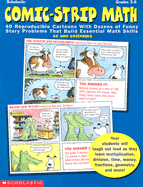
Comic-Strip Math:  Problem Solving: 80 Reproducible Cartoons with Dozens and Dozens of Story Problems That Motivate Students and Build Essential Math Skills by Dan Greenberg.  (2010).  Scholastic Teaching Resources (0545195713).  Gr. 3-6.

This is such a brilliant idea - what a fantastic way to blend art, math, reading,and writing.  Using comics to explore math encourages students to use their visual, verbal, spatial, and logic skills in interpreting situations.  While most of the multiplication exercises in the book incorporate multi-step problems (some of which also ask children to take the next step into division), there is a nice section in the book with lots of fun activities for them to solve (p. 12 - 19).  Each lesson features a comic at the top, which concludes with a "figure it out" question, and then the follow-up questions listed below take on a more-familiar worksheet format.  There are "super challenges" at the bottom of each page to help students extend what they've learned and some encourage them to create their own pictures, diagrams, charts and models.  Consider setting up a math/art center for students to make their own multiplication comic strips. You could use graph paper to help them better design the more traditional story-board layout, or take larger paper and fold it to create frames for students to draw in. Encouraging them to think about and ask multiplication problems through art and humor and then asking them to share them with classmates could be incredibly fun for everyone.
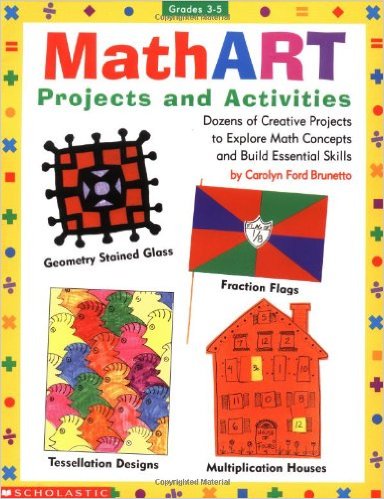
MathART Projects and Activities by Carolyn Ford Brunetto.  (1999).  Scholastic Teaching Resources (0590963716).  Gr. 3 - 5.

This book is full of good ways to connect math to simple art projects, and inside there are two very fun multiplication projects:  multiplication constellations (p. 38 -41), and my favorite idea, multiplication houses to reinforce basic multiplication facts for numbers 1 to 12 (p. 40 - 41).  Using the template, students can create their houses - or if you are more artistically inclined, you can encourage them to create their own houses (or skyscrapers, or other buildings).  For example, if a student creates the house of nine, the number 9 would be written on the door. The numbers 1 to 12 would be written on the house's twelve windows. When you open the window to any given number, you see the product of nine and that number revealed.  Creating these houses for kids to use as lesson guides would be very enjoyable, and if you made large ones for your classroom, you could create your own Multiplication Neighborhood that your students could look at for review.  

Quick and Easy Math Art:  Dozens of Engaging Art Activities That Build and Reinforce Essential Math Skills and Concepts by Deborah Schecter. (2011). Scholastic Teaching Resources (0439199425).  Gr. 2 - 4.  

Here is another great art-math resource offered by Scholastic, chock full of great, inexpensive, and simple projects that anyone can do.  There are a number of very cute multiplication activities (p. 14 - 22):  Be Mine! Multiplication (which you can see in color on the cover of the book), Multiplication Menageries, Fall Factor Trees, and Teeny-Tiny Times Table Books.  The author makes it clear that educators should test out these projects before introducing them to the class - as any art teacher can tell you, figuring out how to do them on your own first can help you determine exactly how you need to model instruction, what steps are important to emphasize, and will help you figure out how complicated (and possibly time consuming) it is going to be.  Many of these multiplication projects would be suitable to use at math centers. 

Friday, September 25, 2015

Books for Math Storytelling Day

September 25th is Math Storytelling Day. Today (every day!) is the perfect opportunity to encourage and nurture the love of mathematics through reading about math. There are many terrific books that include mathematical content or challenging puzzles to solve. Here are some titles that will encourage children to stretch their mathematical muscles in a different way.

The Phantom Tollbooth by Norton Juster - Take a journey with Milo, a young boy who drives through a magic tollbooth into the Lands Beyond and embarks on a quest to rescue the maidens Rhyme and Reason from exile and reconcile the estranged kingdoms of Dictionopolis and Digitopolis. This is a great book for kids enamored of words and/or numbers.

Grandfather Tang's Story: A Tale Told With Tangrams by Ann Tompert and The Warlord's Puzzle by Virginia Pilegard are both stories that revolve around an ancient Chinese puzzle made from a large square cut into seven pieces. The seven shapes include a small square, two small triangles, a medium-sized triangle, two large triangles and a parallelogram. Kids can read the stories and follow along with their own set of tangrams!

The Number Devil: A Mathematical Adventure by Hans Magnus Enzensberger - With full color illustrations, this book tells the story of a twelve year old boy and math hater named Robert, who meets the Number Devil in his dreams. Over  the course of twelve nights, the Number Devil illustrates different mathematical ideas using things like coconuts and furry calculators. Along the way he also takes Robert to Number Paradise where he meets different mathematicians.

Chasing Vermeer by Blue Balliett - Petra and Calder are preoccupied with Vermeer. When a Vermeer painting is stolen in transit from the National Gallery in Washington D.C. to the Chicago Institute of Art, they become intent on finding the painting and solving the mystery. Clues and mysteries abound.
  • Calder carries a set of pentominoes in his pocket at all times, so be sure to print your own set to use while reading this one!
  • Play pentominoes online.
  • Learn more about the book, the author, and the other books in the series at the Scholastic site. 
Brown Paper School Math Books by Marilyn Burns - Don't let the publication dates fool you into thinking these are out of date (one was first published in 1975!). These are great books for helping kids see that math is fun and for everyone.

The Book of Think: Or How to Solve a Problem Twice Your Size
The I Hate Mathematics! Book
Math for Smarty Pants

The Mysterious Benedict Society by Trenton Lee Stewart - Eleven year-old Reynie Muldoon is intrigued by an ad in the paper that asks “Are You a Gifted Child looking for Special Opportunities?” Reynie and dozens of other children show up to answer the ad and take a mind-boggling series of tests, but only Reynie and three others are left at the end. Puzzles and mysteries abound in this adventurous tale. Sequels include The Mysterious Benedict Society and the Perilous Journey and The Mysterious Benedict Society and the Prisoner's Dilemma.

Books by Greg Tang - Greg Tang has written a series of books that encourage children to look for patterns in math and find more "economical" ways of solving problems.

The Best of Times: Math Strategies That Multiply
Grapes of Math: Mind Stretching Math Riddles
Math Appeal
Math Fables: Lessons That Count
Math Fables Too: Making Science Count
Math for All Seasons: Mind-Stretching Math Riddles
Math Potatoes: More Mind-Stretching Brain Food
Math-terpieces
    The Man Who Counted: A Collection of Mathematical Adventures by Malba Tahan - Orginally published in 1949 as O Homem que Calculava, this book of mathematical puzzles was written by Júlio César de Mello e Souza and published under the pen name Malba Tahan.  The book is an enjoyable  series  of "Arabian nights"-style tales, with each story built around a classic mathematical puzzle. In each tale, Beremiz Samir uses his mathematical powers to "settle disputes, give wise advice, overcome dangerous enemies, and win for himself fame and fortune."

    The Puzzling World of Winston Breen by Eric Berlin - Winston sees puzzles everywhere. Imagine his dismay when he gives his sister a box for her birthday, only to learn that it has a secret compartment containing four wood sticks with puzzle clues. Readers will solve puzzles right along with Winston and his sister Katie as they try to solve the mystery. The sequel to this book, The Potato Chip Puzzles, is also highly entertaining.

    Books by Theoni Pappas - Written in the same vein as the Brown Paper School Books, Pappas has written many books about math, my favorites of which are those where a cat explores the math in and around his house.

    The Adventures of Penrose the Mathematical Cat
    Further Adventures of Penrose the Mathematical Cat

      The Origami Master by Nathaniel Lachenmeyer, Lissy's Friends by Grace Lin (picture books), and Fold Me a Poem by Kristine O'Connell George (poetry) are all books about origami. Paper folding is a great visual and spatial puzzler for kids and adults. It's also fun!

      Do the Math: Secrets, Lies, and Algebra by Wendy Lichtman - Tess is an eighth grade girl experiencing typical middle school problems--friends breaking promises, peers cheating on tests, the boy that may-or-may not be interested--as well negotiating some drama at home. Tess examines everything logically and views her world through the lens of mathematics.
      "The way Sammy spoke about her mother made me think of what Venn diagrams look like when the two sets have nothing in common--like, for example, the set of odd numbers and the set of even numbers. Their intersection is called an empty set, because there's nothing in it. There's not one number that can be both odd and even. I didn't like thinking of Sammy and her mother like that--like an empty set." (p.49)
      While the book isn't necessarily about math, Tess has many interesting mathematical insights and how they relate to the world we live in. 

      That's it for now. Do you have a favorite book that offers something mathematical to puzzle over? If so, please share. I would love to add your ideas to this list.

      Monday, September 14, 2015

      Informal, Math-Rich Experiences - The Richmond Math Salon

      This is an old (2010) video, but I keep returning to it because I love the notion of a math salon. 
      A while back I wrote a post describing the components of elementary school homework I believed were important. Here's a description of one of those components.
      Puzzle - When was the last time you sat down to solve a puzzle and did it for fun? I do this all the time. Sudoku, crossword puzzles, jigsaw puzzles, logic problems, tangrams ... I could go on. Puzzles are good for the brain. They develop critical thinking and problem solving skills. They teach kids to persevere, guess and check, collaborate with others, and try a whole host of new strategies. Can you think of a better training ground for mathematical thinking than puzzling? Now imagine if your teacher encouraged you to do this for homework. 
      This is exactly the kind of think happening in this math salon--kids exploring ideas in meaningful ways that just happen to touch on aspects of mathematical thinking. Just imagine what you could do with this idea in a classroom.

      You can read more on my views about homework in the post entitled Elementary School Homework and Reading in Math and Science.

      Monday, September 7, 2015

      How Many Trees Are There On The Planet?

      Last week I was interested in a story I heard on NPR. It began with the question "How many trees are there on the planet?" I started to think about how one would make such an estimation. My guess was 100 billion. Was I close? No. The actual answer is closer to 3 trillion. That's TRILLION, or 3 x 1,000,000,000,000. 

      You can hear the story at NPR in the post entitled Tree Counter is Astonished By How Many Trees There Are.

      And while this sounds like a huge amount (no, we don't have enough), the researchers found that the Earth has lost nearly half its trees since the start of human civilization. We also know that we are losing 10 Billion trees every year. All of this is pretty disturbing. 

      These numbers teach us a lot about habitat loss, how much carbon dioxide is being absorbed from the atmosphere, how water is recycled in an ecosystem, and how we can preserve and replenish our forests. Take a minute to learn more in this video.
      You can read more about the study that produced these data at Live Science in the article Earth Lost Half Its Trees to Humans.

      Wednesday, February 11, 2015

      Honeybees and Hexagons

      "Honeybees are some of nature’s finest mathematicians. Not only can they calculate angles and comprehend the roundness of the earth, these smart insects build and live in one of the most mathematically efficient architectural designs around: the beehive."


      Learn more by viewing the complete Ted Ed lesson by Zack Patterson and Andy Peterson.

      After viewing this you may want to check out this book on patterns and shapes in nature.
      Bees, Snails, & Peacock Tails: Patterns & Shapes . . . Naturally (2008), written by Betsy Franco and illustrated by Steve Jenkins explores surprising and hidden shapes and patterns in nature. Poetic text and cut paper collage illustrations serve as a beautiful vehicle for introducing young readers to these concepts. On a page depicting a snake, a spider hanging from a thread, a snail shell, a bee in flight, an ant, and goose silhouetted against the moon, the text begins this way.
      In the day
      and the night,
      on the land
      and in flight

      tucked in hollows
      of trees,
      in the tide pools
      and seas,

      you'll find patterns and shapes—
      from the snakes to the bees!
      The next page reveals the genius behind a beehive. This is one of my favorite spreads in the book—not only do I love the text, but I could spend hours staring at the bees on the hive. The layers upon layers of paper used to create the illustration are stunning. The text that accompanies it reads:
      Study a beehive
      and you will see
      the mathematical genius of the bee.

      The hexagons
      you'll find inside
      fit side
      by side
      by side
      by side.
      This math is passed
      mysteriously
      from worker bee
      to worker bee!
      *Swoon* Beautiful images and beautiful words—what better tools are there to introduce nonfiction to young readers? None that I can think of. 

      Franco and Jenkins next explore moths, the stunning symmetry of a spider's web, the dazzling feathers of the male peacock, the familiar V of migrating geese, the teamwork and formation of members of an ant colony, the geometry of animal tracks (a mouse in the snow), the shapes on diamondback snakes, the radial symmetry of sea stars, the shape of a puffed-up puffer fish, and the spirals of a snail shell. The text/poem on the shell page is written in the same spiral form displayed by the shell.

      The text ends with the same background as the opening spread, though presented at nightfall with some different animals on the page. There are eyes inside a hole in the tree, sea stars on a rock, a moth flitting in the moonlight, and a spider now resting on a completed web. The text reads:
      So there you have it . . . .
      I think you'll agree

      that creatures
      on land,
      in the air,
      in the sea

      make patterns and shapes
      quite naturally!
      Text ©Betsy Franco. All rights reserved. 
      The end matter of the book is titled New Angles on Animals and provides a brief bit of information on each of the animals highlighted in the pages of the text.

      While I plan on using this book for math to talk about shapes and patterns, I can also see it being used in science to discuss camouflage and other animal adaptations. This is a gorgeous book in both writing and illustration. I highly recommend it.

      Sunday, December 28, 2014

      Finding Math in Van Gogh's Starry Night

      Turbulence is a concept that is difficult to model and understand. Amazingly, Van Gogh captured it in his work Starry Night.


      Learn more by viewing the complete TED Ed lesson by Natalya St. Clair.

      Saturday, December 6, 2014

      One Million (and One) Digits of Pi

      The team at Numberphile printed one million decimal places of Pi onto a piece of paper. Can you guess how long it stretched? Or which digit appeared most often? Watch this video to learn the answers to these questions and more.


      Once you've seen the video, check out the related TED Ed lesson.

      Thursday, March 13, 2014

      Pi Day is Tomorrow ... But Should We Celebrate It?

      All you math lovers out there should know that tomorrow is Pi Day. But should we celebrate pi or tau? Don't know what I'm talking about? Take a look at these two videos.
       

      Learn more about Tau by reading The Tau Manifesto by Michael Hartl.

      Pi Day Is Tomorrow!

      Tomorrow, March 14th, is Pi Day. No, that's not a typo. It is Pi day, as in 3.14159... you get the idea. The first Pi Day celebration was held at the San Francisco Exploratorium in 1988.

      What is pi anyway? I'm sure you remember it from math in some formula you memorized, but do you really know what it is? Pi represents the relationship between a circle’s diameter (its width) and its circumference (the distance around the circle). Pi is always the same number, no matter the circle you use to compute it. In school we generally approximate pi to 3.14 in school, but professionals often use more decimal places and extend the number to 3.14159. You can learn even more about pi at Ask Dr. Math FAQ: About Pi.

      One activity I loved doing with students was to ask them to bring in a can and lid that would soon be recycled. I always brought in a few extras so that there would be a variety of sizes. Each student was given a lid and directed to measure the diameter and circumference. Students then divided the circumference by the diameter. We recorded the results on the overhead and discussed them. Most were amazed to find that the results were nearly the same, allowing for some margin of error in measurement. This is a quick and fun and provides a meaningful way to introduce the concept of pi.

      Are you doing anything special for Pi Day? Perhaps you could make a pi necklace or a pi bracelet. Can you find your birthday in pi? My birthday begins with digit number 7669! Since any day is a good day for poetry, you could try reading some pi poems. If you are looking for more ideas, visit the Exploratorium pi site or try this middle school math newsletter. Finally, you can visit my Pinterest board for additional resources.

      Follow the board Circle Measures/Pi on Pinterest.
      **Download your own version of the Pi poster (in green or purple!) at the Unihedron Pi Poster page.**

      Saturday, December 14, 2013

      Why Do We Learn Mathematics? - Calculation, Application, and Inspiration

      I love this TED Talk by Arthur Benjamin on The Magic of Fibonacci Numbers. I particularly like the introduction. Here's how it begins.
      "So why do we learn mathematics? Essentially, for three reasons: calculation, application, and last, and unfortunately least in terms of the time we give it, inspiration. 
      Mathematics is the science of patterns, and we study it to learn how to think logically, critically and creatively, but too much of the mathematics that we learn in school is not effectively motivated, and when our students ask, "Why are we learning this?" then they often hear that they'll need it in an upcoming math class or on a future test. But wouldn't it be great if every once in a while we did mathematics simply because it was fun or beautiful or because it excited the mind?"
      I've been a puzzle-solver and game player for as long as I can remember. I love to do math for fun. I wish more teachers saw the value of puzzling through non-traditional problems and the long-term benefits it brings.

      Learn more about these ideas and the beauty of Fibonacci numbers in Benjamin's talk.


      Friday, November 8, 2013

      My Classroom - Organizing Math

      Several folks have asked me to describe my classroom. Since I share a space with other faculty members, I don't have a dedicated classroom, though the University added cabinets for me last summer so that I wouldn't have to drag all my materials up and down the stairs or from the closet down the hall.

      I spend about an hour each afternoon pulling materials and setting up for my class. Here's what the room looked like this week as I set up for class. This session was focused on fractions and decimals.
      Students sit in groups of 4 and work throughout the 3-hour session in the whole group and with their table partner. The classroom can hold 20 students, but it's really crowded at capacity. I move around a lot, and a full class makes this nearly impossible. Right now I have a very manageable class of 14.

      I come to class each week with a bag or box of books. I start by putting children's literature titles related to the topic around the room. Then I open the cabinets and pull out boxes of manipulatives, game sets, art/supply boxes, and more. I put a class agenda at each seat and set out materials for each group/pair. Sometimes they have paper manipulatives to cut out. The art/supply boxes contain scissors, glue sticks, highlighters, rulers, colored pencils, crayons, tape, and more. Just about anything they might need for interactive notebooks is in here.

      The game sets contain an assortment of dice (traditional, pattern block, fraction, 10-sided, 4-sided, etc.), transparent spinners, a deck of cards, and 2-colors of transparent chips (30 each). These great little containers are from the Dollar Tree. Each pair gets one of these boxes.

      I also use these containers for base-10 blocks. Each box contains 20 tens, 5 hundreds, and 100 ones.
      (The amazing Janaye of Tales of Frogs and Cupcakes shared this idea back in March of 2012 in a post on math manipulative storage and I ran with it!)

      Here's what the tables looked like just before the students arrived. There was one set of pattern blocks and an art/supply box per table group. For each pair there was a game set, base-10 blocks, fraction circles, and fraction strips.

      Students pick up any handouts and additional materials from the storage countertop.

      Here's what you'll find inside those cabinets.

       
      You'll notice that while it's easy to find things, these containers are woefully lacking in labels! Those round containers you see are also from the Dollar Tree. Here's what they hold.
      This particular set of Cuisenaire rods is missing the dark green rod (#6)!  I do like these containers, though they they take up more storage space than the divided rectangular containers. (Hey, when you shop at the Dollar Tree you take what you can get, and you never know what will be in stock!)

      I also recycle containers from home, including milk jugs, rice jars, peanut butter jars (only after putting through the dishwasher at least 3 times), tea tins, and more. Here's how I store my collection of foam beads (from Oriental Trading).
      And here's how I store all my extra colored pencils. This idea came from Pinterest (where else?)!


      So that's it for my math materials and a bit about how I organize and set up. My apologies for some of the fuzzy pictures. 

      If you are looking for even more ideas you can find a wealth of them (and free manipulative labels!) from teachers far more ingenious than me on my Organizing Math board.


      How do you organize your math materials, at home or in your classroom? If you have a new or tired-and-true idea, please share it!

      Wednesday, October 23, 2013

      Instructional Conundrum: 100 Board or 0-99 Chart?

      In my work with preservice teachers I find myself thinking a lot about the language of math and the models we use. Today I want to discuss the differences between the 100 board and 0-99 chart.


      In some circles, the 0-99 chart is also called a 100 board. In old-school language it is called a counting chart. I don't particularly like either of these names. Here's why.
      1. Even though 100 numbers are represented on the 0-99 chart, it does not extend to 100. To be called a 100 board, it should include this number.
      2. A counting chart should begin with the first counting number, which is 1. Zero is not a counting number. Therefore, a chart that begins with 0 should not be called a counting chart.
      I know these are really minor points, but they speak to the issue of precision and the language we use to describe mathematical tools. 

      Beyond the semantic issues of what we call these charts, I have greater concerns about the use of 100 board (and the 120 board we now see to support Common Core standards).

      Our system of numeration is a base-10 system. This means we have 10-digits (0-9) and that every number can be made using one or more of these digits in combination. Ten and powers of ten are used to construct the system.  Larger numbers are built by repeatedly bundling ten: 10 ones make one ten, 10 tens make one hundred, 10 hundreds make one thousand, and so on. In simpler language, every time we reach ten of a particular unit, it is regrouped and renamed. Here's what the tens column looks like on these charts. Note the placement of each.


      This is where my problem with the 100 board comes in. When we reach 10 ones on a hundred board, they still remain in the ones row (or column, depending on how the chart is arranged), but they belong at the beginning of the next decade. On a 0-99 chart all the numbers in a decade appear in the same row. For example, on a 100 board, the decade row for thirty begins with 31 and ends with 40. On a 0-99 chart, the decade for the thirty row begins with 30 and ends with 39. 


      This representation on the 0-99 chart is much clearer and more accurately represents the way our number system operates. 

      The other idea the 0-99 chart makes explicit is that zero is an even number. Even though we don't begin counting with 0, placing it on the board shows students that one less than 1 is 0 and that zero IS a number! On a 100 board we recognize numbers ending in 0 as even, but because zero does not appear, students don't view it as a number (just a placeholder) and often question its classification, wondering if it is even, odd, or neither. The 0-99 chart can help students overcome these misconceptions.   

      In the final analysis, both charts can be used for developing skills in counting up and counting back, skip counting, finding one more/one less and ten more/ten less than a number, recognizing patterns, place value, addition, subtraction, finding multiples, prime numbers, and more. However, the 0-99 chart does this while helping students work within the structure of our base-10 system.

      Now that I've articulated the reasons that I feel the 0-99 chart is a better tool than the 100 board, here's a set of charts for you to use. One is a traditional 0-99 chart (oriented horizontally), while the other displays the numbers vertically.
      Download 0-99 Charts.

      What are your thoughts about the difference between the 100 board and the 0-99 chart? Which do you prefer and why?

      Thursday, August 15, 2013

      Connecting Math and Science to Agriculture

      I've been a strong supporter of Agriculture in the Classroom for many years now. We in Virginia are fortunate to have an excellent program with a terrific team of writers and facilitators. I invite them to my class every semester so that my pre-service teachers can see how agriculture concepts and ideas can easily be integrated into the curriculum.

      Here are a few of the outstanding resources they share with teachers EVERYWHERE (not just in VA).
      Math Ag-tivities contains more than 130 pages of lessons and reproducibles for grades K-6. Each lesson incorporates interesting information about agriculture along with the mathematics concepts. Students gain skills to solve math problems while learning agricultural facts about livestock, various commodities, and plant growth.

      The Garden Chef: Cooking Through the Food Groups provides teachers with a cooking and activity book that incorporates skills from the core subject areas. This book is divided by the five major food groups: Grains, Vegetables, Fruits, Milk, and Meat & Beans. The recipes feature nutritionally wholesome foods and contain extension ideas for teachers to use in elementary school classrooms.


      Barnyard Banter is a collection of quick lessons and activity ideas to accompany 29 different books with an agricultural theme.


      Jump Start Your School Garden is a guide intended to help educators integrate the use of the garden - whether it is an outdoor garden or an indoor container garden - into their science and mathematics curriculum. Additionally, tips and suggestions have been included for schools who hope to begin a garden or to enhance an existing one.

      You'll find many more resources, like a searchable lesson plan database and extensive booklist, on their Teacher page. On the Volunteer page you'll also find some quick, fun activities.

      I know I've left you much to explore, but before you go, have a bit of fun with the Peterson Brothers and think about how important agriculture is to each and every one of us.