Tuesday, October 11, 2011

Unit Resource Portfolio: Ecosystems

Unit Outline for SOL 4.5 Ecosystems


Day 1: Introduction to Ecosystems: SOL 4.5 d: Habitats and Niches

Objectives: Students will
  • Understand that an ecosystem is made of living and nonliving things
  • Be able to tell the difference between an ecosystem and a habitat
  • Create their own miniature ecosystem and identify how the different living and nonliving parts of that ecosystem contribute to that ecosystem.
Students are asked to observe the class fish aquarium and are asked why the fish aquarium is a habitat and how it is an ecosystem. Students are read the book What are Food Chains and Webs? Students watch video: Habitat, which explains what a habitat is and also what a niche is. Students are asked by the teacher some discussion questions that go with the movie which they must answer in their science journals after the movie. Students are given a graphic organizer which allows them to enter the information answered by the video/teacher/students and the handout information. This graphic organizer is handed in for a grade and the teacher uses a rubric to grade it. Teacher makes two collumns on the board and asks students what the characteristics of an ecosystem, habitat, and niche are and fills in all of the information. Students make a foldable which defines ecosystem, habitat, and niche.

Day 2:Ecosystems: SOL 4.5 d.: An Introduction to Different Ecosystems
Objectives: Students will:
  • Discover that different types of land and therefore weather accommodate/attract different types of living things
  • Be able to name several different types of ecosystems
Students are asked about different ecosystems they may have observed during travels or on T.V.. Students are read the book Crinkleroot's Guide to Knowing Animal Habitats by Jim Arnosky. Students watch a video: Wetlands, Forests, & Deserts, which teaches students how surface terrain affects the precipitation and temperature which in turn affect living things in an ecosystem. Students answer questions which go with the movie Wetlands, Forests, & Deserts, and record the answers in their science journals. This is turned in for a grade. Students play on their class laptops Biomes, an interactive game which teaches them about biomes and is followed by discussion questions, which they must record in their science journals, also to be turned in for a grade. The teacher uses a rubric to grade the science journals. Students make a foldable which represents information that they learned about the different animal habitats from Biomes.

Day 3: Ecosystems: SOL 4.5 d.: Habitats & Niches: The Wetland Habitats
SOL 4.5 f.: Affects of Humans on an Ecosystem
Objectives: Students will:
  • Discover the characteristics of a wetland ecosystem
  • Learn what the wetlands are like as a habitat for living things
  • Explain how wetland habitats can be changed by humans
  • Explain how wetland habitats can be changed by natural causes

Students are asked: What kinds of animals and plants occupy wetland habitats? and How do you think a wetland ecosystem differs from any other ecosystem? Students are read the book: AJourney into a Wetland by Rebecca L. Johnson. Students watch a video:
An Everglades Visit and answer the questions that go with it after the teacher writes them on the board. Students play on their class laptops Florida's Everglades, which is an interactive lesson. Students make Wonderful Wetlands experiment in groups of 5 to explore how a wetland ecosystem is naturally equipped to resist pollutants through absorption. Questions are included in the experiment, which students answer in their science journals. Students watch video: Hurricane Katrina: Wetland Destruction to see how natural disasters can affect a wetland ecosystem.

Day 4: Ecosystems: SOL 4.5 d.: Habitats and Niches: Forests
SOL 4.5 f.: Effects of Humans on an Ecosystem
Objectives: Students will
  • Be able to notice specific similarities and differences among boreal, temperate, and rainforest ecosystems.
  • Observe characteristics of a boreal forest
  • Observe characteristics of a temperate forest
  • Determine how these ecosystems are threatened
Students are read the books A Walk in the Boreal Forest and A Walk in the Deciduous Forest. Students watch Biome in a Baggie video, which explains with an experiment how, with similar temperatures and precipitation, it is possible for two forests located in different parts of the world to have the same plants. They answer the included discussion questions in their science journals after the teacher has written for them on the board. The teacher asks them to answer the questions out loud to make sure everyone understands. Students listen as teacher tells a story about a town that was outnumbered by deer and then watch a short video about deer from a wildlife biologist's point of view: What's Your Problem?, Teacher leads a discussion by asking students why they think the population of deer is out of control in some areas. . A rubric is used to grade the handout. Students play a game to learn how populations of wolves can easily change in the wild: Wolf Population Game.

Day 5: Ecosystems: SOL 4.5 d.:Habitats and Niches: Rain Forest
SOL 4.5 f.: Human Effects on an Ecosystem
Objectives: Students will
  • Understand the characteristics of a rainforest
  • Understand the human threat to rainforests
Students are read the book Rain Forest Animals by Carolyn Franklin. Teacher shows students a World Trust webcam of Southern Atlantic rainforest in Brazil. Teacher asks students how the rainforest ecosystem might differ from the other forest ecosystems. Students watch video Amazon Rainforest and then answer the included discussion questions in their science journals.Students break up into groups of four to research on their class laptops and in classroom books one species of animal that lives the rainforest. They will find out the risks to it's survival and details about behavior and habitat. They will make a poster and present this information along with a drawing of the animal. Each group will present their project to the class at the end of class.

Day 6: Ecosystems 4.5 d.: Habitats & Niches: Coral Reef
4.5 f: Human Effects on an Ecosystem

Objectives: Students will
  • Learn about nonliving and living contributors to a coral reef ecosystem
  • Find out the human and natural threats to a coral reef ecosystems
Students are read the book The Seaside Switch. Students watch video: Coral Reef Connections and then answer the included discussion questions that the teacher writes on the board. Students will participate in activity from Contrasts in Blue: Life in the Carribean Coral Reef
where they will receive a handout and then fill in information about the coral reef food chain.

Day 7: Ecosystems 4.5 d.: Habitats & Niches: Deserts
Objectives: Students will

  • Learn about living and nonliving contributors to a desert ecosystem.
  • Find out about threats to the desert ecosystem
Students are read the book A Desert Habitat. Students watch video Desert Biome and then answer included discussion questions in their science journals. Students watch video Desert Tortoise and answer included discussion questions afterwards. Students research on their laptops 3 desert plants or animals and make a foldable which explains how each contributes to the desert ecosystem, what each does to obtain food and water, etc.

Day 8: Ecosystems 4.5 d. Habitats & Niches: Tundra & Arctic Habitats Part 1
4.5 f. Human Effects on an Ecosystem

Objectives: Students will
  • Be able to describe an arctic ecosystem.
  • Be able to describe a tundra ecosystem
  • Determine what living and nonliving things make up an arctic ecosystem
Students are read the book A Walk in the Tundra. Students watch video Arctic Tundra and then answer the included discussion questions in their science journals to be turned in for a grade. Students are read the book Life Under Ice and the teacher asks the students if they can think of any other plants or animals that are suitable for life in a very cold or icy ecosystem. Students then watch the video Arctic Ecosystem and answer the discussion questions in their journals to be turned in for a grade.

Day 9:Ecosystems SOL 4.5 d. Habitats & Niches: Arctic Habitats 2
4.5 f. Human Effects on an Ecosystem

Objectives: Students will
  • Learn about living and nonliving components of the arctic ecosystem
  • Discover natural contributors to changes that are occurring in arctic ecosystems
  • Discover human contributors to changes that are occurring in arctic ecosystems
Students will watch the video Arctic Summer to get a better idea of what seasons look like in arctic ecosystems. They will answer the included discussion questions in their science journals. Students watch Arctic Haze, Contaminants in the Arctic Food Chain, and How the Arctic Ecosystem Might Change to learn about the natural and human-caused reasons why the Arctic ecosystem is changing. They answer the included discussion questions for these videos in their science journals.

Day 10: Ecosystems SOL 4.5 d. Habitats & Niches: Conclusion
Objectives: Students will
  • Review nonliving and living characteristics of the ecosystems that we studied
  • Review human and natural contributors to changes in the ecosystems
Students will again play Biomes for review and their scores will be graded.


Curriculum Framework Background for SOL 4.5 d and f.


The concepts developed in this standard include the following:
· Organisms have structural adaptations, or physical attributes, that help them meet a life need.
· Organisms also have behavioral adaptations, or certain types of activities they perform, which help them meet a life need.
· The organization of communities is based on the utilization of the energy from the sun within a given ecosystem. The greatest amount of energy in a community is in the producers.
· Within a community, organisms are dependent on the survival of other organisms. Energy is passed from one organism to another.
· The organization of a community is defined by the interrelated niches within it.
· The sun’s energy cycles through ecosystems from producers through consumers and back into the nutrient pool through decomposers.
· An organism’s habitat provides food, water, shelter, and space. The size of the habitat depends on the organism’s needs.


Unit Resource Portfolio: Living Systems

Introduction
In this post you will find several resources for teaching the 5th grade unit on living systems. Teaching this unit can be challenging because there is a lot of material to cover, and there are several important vocabulary words that are essential for students' understanding of the content. The following links to and ideas for instruction, literature, websites, foldables, and assessments should prove beneficial in teaching the living systems unit.

Virginia Standards of Learning 5.5. The student will investigate and understand that organisms are made of one or more cells and have distinguishing characteristics that play a vital role in the organism's ability to survive and thrive in its environment. Key concepts include
a) basic cell structures and functions;
b) kingdoms of living things
c) vascular and nonvascular plants; and
d) vertebrates and invertebrates

Background from Curriculum Framework
  • Living things are made of cells.
  • Cells carry out all life processes.
  • New cells come from existing cells.
  • Cells are too small to be seen with the eye alone.
  • Plant cells tend to be rectangular, while animal cells tend to be spherical or irregular.
  • Living things can be categorized into kingdoms: monerans, protists, fungi, plants, and animals.
  • Plants can either be vascular (having special tissues to transport food and water) or nonvascular (not having tissues to transport food and water. Most plants are vascular
  • Animals can be categorized as vertebrates (having backbones) or invertebrates (not having backbones)
Important Unit Vocabulary
-cell wall: located outside the cell membrane; provides structure and protection for the cell
-chloroplasts: food producers
-cilia: contribute to movement within the cell
-cytoplasm: fluid that fills the cell
-invertebrates: animals that do not have backbones
-lysosomes: vessel that holds enzymes and helps digest things
-multicellular: many cells
-nonvascular: plants that do not have special tissues to move nutrients
-plastids: storage for important chemical compounds
-unicellular: one cell
-vacuole: stores nutrients
-vascular: plants that have special tissues to move nutrients
-vertebrates: animals that do have backbones

Instructional Plan


Day 1: What is a cell?
Objectives: Students will...
  • be able to describe the essential functions of a cell.
This class period will begin with a discussion about cells. The teacher will ask the students what they already know about cells, or what they think cells are and do. As students tell what they know about cells, the teacher will write these ideas on the board. Following the class discussion, the teacher will then go into instruction, and provide each student with notes that mirror the teacher's instruction. After the teacher has presented the content, students will be given time to write their own definition for a cell and illustrate the cell's main functions. At the very end of class, the teacher will present students with a cell project. Each student will have to construct a 3D representation of a cell using any materials that they choose.

Day 2: Plant & animal cell
Objectives: Students will...
  • be able to compare and contrast plant and animal cells with the use of a venn diagram
The class will begin with the students and teachers asking the students to recap what they learned the previous day about the cells functions. The teacher will then state how the functions a cell can perform are related to the cell's structure. The teacher will develop the lesson further by presenting key vocabulary to students and describing the structure of both plant and animal cells. Towards the end of class, the students and teacher will collectively fill out a venn diagram of plant and animal cells.

Day 3: Plant & animal cell similarities and differences
Objectives: Students will...
  • develop further understanding of cells through observation and brainstorming
At the beginning of class, the teacher will ask a few students to briefly summarize the material that had been covered the previous day. For the next 20 minutes of class, the teacher will have the students color and label pictures of a plant cell and an animal cell. For the last 10 minutes of class, the teacher will present several cell images to the students, and the students will have to individually determine whether the cell is plant or animal. The teacher will collect these answers for assessment. For homework, or as a part of the lesson, the teacher can instruct students to create this shutter fold venn diagram to compare and contrast plant and animal cells.

Day 4: Organism characteristics and classification
Objectives: Students will...
  • be able to identify characteristics of organisms
  • describe the process of grouping organisms based upon their characteristics
This lesson will begin with a Biology Video. This will introduce students to the instruction for the day, getting students thinking about characteristics of all living things. The students will then be instructed to brainstorm other characteristics the living things have. The teacher will then introduce the five kingdoms of living things. It may be able to show the class this Study Jams Video about the five kingdoms. The teacher will spend time talking about each kingdom starting with monerans.

Day
5: Organism characteristics and classification
Objectives: Students will...
  • be able to group organisms into kingdoms based upon their characteristics.
This class will begin with a quick summary of the previous day's instruction. The teacher will then cover the remaining kingdoms that were not covered the previous day. The teacher will demonstrate to the students how to create a foldable that will allow the students to group organisms into kingdoms based upon their characteristics. The foldable booklet contains a pocket for each kingdom so that students can cut organisms out and categorize them, placing them in the appropriate pocket.

Day 6: Vascular vs. nonvascular plants

Objectives: Students will...
  • be able to describe the differences of vascular and nonvascular plants and categorize plants according to those characteristics.
On day six of the unit, students will learn the difference between vascular and nonvascular plants. The teacher should present the material to students and allow for plenty of examples of both categories. This categorization game may be a beneficial way to close the day's lesson.

Day 7: Vertebrates and invertebrates
Objectives: Students will...
  • be able to describe the differences of vertebrates and invertebrates and categorize animals according to those characteristics
This class period will begin with a very short video about vertebrates and invertebrates. As with vascular and nonvascular plants, teachers should provide the students with many examples of vertebrates and invertebrates, and many opportunities for categorization. The 2-flap foldable can also be used for vascular and nonvascualr classification.

Day 8: Group exploration of websites and literature

Collaborate with your school librarian to allow students to research websites and books on the content. This may include a trip to the library for books and computer use, or having your librarian bring you a cart of books on the content that students will be able to explore. The teacher could also have students complete this Cells and Living Things WebQuest.

Day 9: Presentation of cell projects

Have each student present their cell model to the class.

Day 10: Review

Divide the class up into groups of three or four students for a trivia game of the unit content.

Foldable Resources

Literature Connections

Animal Cells and Life Processes by Barbara Ann Somerville. 2010. 48p. Heinemann Raintree, (9781432938772). Gr. 3-6. This book explores the features of the animal cell.

Animals of the World. 2003. DK Children Publishing, (9780789496034). Gr. 3-6. Covering all of the primary animal groups, this well-illustrated book fun facts and loads of information on the animal kingdom.

Cell Wars by Fran Balkwill. Illus. by MIC Rolph. 1990. 30p. Carolrhoda Books, (9780876146378). Gr. 2-6. This book explores how the body is made up of cells and the purpose the cells serve. It particularly addresses how cells fight off diseases in the human body.

I Know How My Cells Make Me Grow
by Kate Rowan. 2000. 32p. Walker Childrens Paperbacks, (9780744572346). Gr. 3-6. This picture book is about a boy who learns from his mother that he is made up of cells, and these cells are contributing to his growth.

Plant and Animal Cells: Understanding the Differences Between Plant and Animal Cells by Judy Yablonski. 2005. 48p. Rosen Publishing Group, (9781404203242). Gr. 3-6. This book tackles both plant and animal cells. The book includes information and comparisons of both types of cells.

Plant Cells: The Building Blocks of Plants by Darlene Stille, Illus. by Eric Hoffman. 2006. 48p. Compass Point Books, (9780756517649). Gr. 5-8. This book specifically explores the building blocks of plant cells.

The Beauty of the Beast: Poems from the Animal Kingdom by Mielo So. Illus. by the author. 2006. 112p. Knopf Books for Young Readers, (9780679870586). Gr. 3-7. This collection of poems about the animal kingdom is arranged intro five zoological classifications.

The Diversity of Life: From Single Cells to Multicellular Organisms by Robert Snedden. 2007. 48p. Heinemann Raintree, (9781432900380). Gr. 3-7. This book explores how everything around us is made up of cells. This book also takes a look at classification of species.

Sponges, Jellyfish, and Other Simple Animals by Daniel Gilpin. Illus. by Steve Parker. 2006. 48p. Compass Point Books, (9780756516147). Gr. 3-6. This book covers Animal Kingdoms classification for many simple animals.

What Is the Animal Kingdom? by Bobbie Kalman. 1997. 32p. Crabtree Publishing Company, (9780865058897). Gr 1-5. The great text and illustrations of this book provide a great introduction to the Animal Kingdom.

Additional Web Resources


Classifying Critters
This classification game allows participants to group and pair animals based upon their characteristics.

Interactive Cell Animation
This website provides a great visual of both plant and animal cells. Students can separately look the both cells to learn more about the cell's structures and functions.

The Kingdoms of Life
Here, students can explore more about the animal kingdom. They can watch an approximately 3 minute video on the animal kingdom and classification, learn a song, and test themselves on their knowledge.

Who Wants to be a Millionaire: Cells
This game includes all questions related to cell properties, structure, and functions.

Who Wants to be a Millionaire: 5 Kingdoms of life
This games includes questions related to the five kingdoms of life and classification.

Assessment Resources


Cell Quiz

Cells and Microbes Quiz

Kingdoms of Life Categorization

Living Systems Quiz

Plant Quiz: Vascular vs. Nonvascular

Monday, October 10, 2011

Unit Resource Portfolio: Volcanoes and Plate Tectonics

Volcanoes and Tectonic Plate Movement: 
What is up with the Earth?

I. Introduction
In this post you will find websites, books, assessment guides, foldable resources and lesson plans for teaching fifth grade students about volcanoes. This post explores the background of what makes volcanoes, such as layers of the earth's crust, what and where are the tectonic plates, how they move, how the movement impacts volcanoes, how lava is made, where lava is made, different types of volcanoes, where volcanoes are found, and how volcanoes affect the Earth.

A. Virginia Standards of Learning
5.7 The student will investigate and understand how Earth’s surface is constantly changing. Key concepts include
d) the basic structure of Earth’s interior;
e) changes in Earth’s crust due to plate tectonics.
B. Curriculum Framework Background Information
  • Scientific evidence indicates that Earth is composed of four concentric layers — crust, mantle, outer core, and inner core — each with its own distinct characteristics. The outer two layers are composed primarily of rocky material. The innermost layers are composed mostly of iron and nickel. Pressure and temperature increase with depth beneath the surface.
  • Earth’s thermal energy causes movement of material within Earth. Large continent-size blocks (plates) move slowly about Earth’s surface, driven by that thermal energy.
  • Geological features in the oceans (including trenches and mid-ocean ridges) and on the continents (mountain ranges, including the Appalachian Mountains) are caused by current and past plate movements.
  • Most earthquakes and volcanoes are located at the boundaries of the plates (faults). Plates can move together (convergent boundaries), apart (divergent boundaries), or slip past each other horizontally (transform boundaries, also called strike-slip or sliding boundaries).
To teach these ideas, we begin with the basic layers of the earth's crust and how they affect volcanoes, we then move on to what are tectonic plates, what do they do and how do they impact volcanoes, then we go to what is a volcano made of and why do some have lava and some don't, then we describe the different kinds of volcanoes and where they are, then we go to the locations of volcanoes and how these are directly a result of tectonic plate movement. Finally, we discuss where volcanoes are going, where new eruptions may be and why.

C. Vocabulary

1) Convection currents-a circular current caused by the difference in temperatures from the bottom to the top of the mantle. It is because of these currents that the plates of the Earth have moved in the past and are moving today. These plate movements cause earthquakes, mountain building, and volcanism.

2) Eruption-When magma and gas from under a volcano reaches the Earth's surface.

3) Fault-Cracks or fractures in the earth's crust.
Types of movement at faults
  • Convergent boundary -A boundary in which two plates collide causing immense mountain building (Ex: Indian plate and the Eurasian plate forming the Himalayan Mountains) and one plate riding above the other driving the thinner denser plate down into the mantle creating a subduction zone.
  • Divergent boundary -A boundary in which two plates are separating. The two plates are moving in opposite directions and as they spread apart magma fills the void causing the formation of new crust. Divergent boundaries cause the oceans to spread apart while convergent boundaries cause the oceans to shrink.
  • Transform boundary -A boundary in which two plates scrape and slide past each other. Transform boundaries are like tears in the Earth's crust. An example is the San Andreas Fault in California.
4) Geologist-Scientist who studies the Earth.

5) Lava-What magma is called when it flows on the earth's surface, can be a liquid or cooled to solid rock.

6) Layers of the Earth

  • Inner core-860 mile thick layer which is a ball of solid metal, nickel and iron at the center of the earth.
  • Outer core-1400 mile thick layer which is mixture of melted rock and iron.
  • Mantle-middle layer of earth made of flowing rock that is 1800 miles thick.
  • Crust-Earth's rocky outer layer. It is 2-5 miles thick under the ocean and 5-25 miles thick on land.

7) Magma-hot, melted rock below the Earth's surface.

8) Magma chamber-a huge space under a volcano, filled with hot melted rock.

9) Mid-ocean ridges-Formed at a divergent plate boundary. The world’s longest continuous mountain range over 40,000 miles long. Where the two plates separate lava fills the void causing new crust to be produced. Mid-ocean ridges are ocean spreading zones.

10) Pangaea-Super continent 250 million years ago. The seven continents were all connected together into one huge land mass.

11) Pyroclastic flow-pyroclastic flow is a fluidized mixture of solid to semi-solid fragments and hot, expanding gases that flows down the sides of a volcano. These awesome features are heavier-than-air emulsions that move much like a snow avalanche, except that they are fiercely hot, contain toxic gases, and move at phenomenal, hurricane-force speeds. They are the most deadly of all volcanic phenomena.

12) Pacific Ring of fire-an area of frequent earthquakes and volcanic eruptions encircling the basin of the Pacific Ocean. The Ring of Fire has 452 volcanoes and is home to over 50% of the world's active and dormant volcanoes. Ninety percent of the world's earthquakes and 81% of the world's largest earthquakes occur along the Ring of Fire.

13) Subduction zone-Formed at a convergent plate boundary. One plate is lighter and thicker than the other causing the thinner denser plate to be driven down into the mantle. Subduction zones are areas of the world in which high amounts of earthquakes and volcanism is present. Subduction zones are ocean shrinking zones.

14) Tectonic plate-Areas where the earth’s crust has combined with the fluid upper part of the mantle that have formed 12 huge plates that are moving at a very slow pace across the surface of the earth.

15) Trenches-Form at subduction zones. They are the deepest part of the oceans and the lowest points on the crust of the Earth.

16) Volcano-mountains that emit hot gases and melted rock from deep within the earth. Types of volcanoes include:

  • Dormant volcano-volcano that has not erupted for a long time but may erupt in the future. 
  • Stratovolcano-Classic cone shaped volcano that are formed in subduction zones, the place where two tectonic plates meet and where the heavier oceanic plate slides beneath the lighter continental plate, such as Mount St. Helens. Also called a composite volcano.
  • Rift Volcano-Volcano caused when two tectonic plates slide away from each other, creating an opening in the crust that allows magma to flow to the surface, such as Mount Kilimanjaro in Tanzania.
  • Hot Spot Volcano-These occur within a tectonic plate instead of at its edges are look like holes punched in the middle of a pie crust, such as Mount Kilauea in Hawaii. Also called shield volcanoes.
  • Cinder Cone-small volcano with steep sides and a cylindrical shape built from ejected rock fragments.


II. Instructional Plan
Below is a set of 10 lesson plans to use for exploring the world of plate tectonics and volcanoes. They include activities, handouts and foldables. The lessons are sequential for ease of use.

Day 1-Layers of the Earth
This lesson discusses the four layers of the Earth: the crust, the mantle, the outer core and the inner core. The lesson also covers the contents of the layers. It discusses how within the mantle there is a fluid outer mantle and a more hard inner mantle. The fluid outer mantle and the earth's crust make up a layer called the lithosphere. The lithosphere is broken into 12 plates that move on top of the harder inner mantle and are the basis for the theory of plate tectonics. The students will use a hands-on activity with and apple to better understand the layers of the Earth.

Objectives
The students will be able to

  • Name and label the four layers of the Earth;
  • Identify the main minerals that make up each layer;
  • Explain how scientists formulated the idea that the Earth is comprised of four layers.

Lesson Resources

Day 2-Pangaea to the Present
This lesson takes students on a historical carpet ride through millions of years of plate movement. Utilizing the concept of the lithosphere, it introduces the concept of continental drift and what may happen in the future with the continents. It also contains a hands-on activity to have the students make the movement of the continents themselves.

Objectives
The students will be able to

  • Demonstrate how the Earth's plates have moved.
  • Describe the processes that cause plate movement.

Lesson Resources


Day 3-How and why do tectonic plates move?
Students take the historical lesson of day 2 and see how it works today as the tectonic plates are continuing to move around the earth. Students will learn about the engine that drives plate movement, convection currents in the mantle, and will see the results of different types of plates colliding with, moving away from and sliding next to each other. Also included with this lesson is a Earth map foldable which opens to show where the tectonic plates are on the Earth.

Objectives
The students will be able to

  • Become familiar with and be able to demonstrate the process of folding;
  • Become familiar with the process of convection current movement in the asthenosphere;
  • Become familiar with processes that produce convergent, divergent, and transform plate boundaries.

Lesson Resources


Day 4-How to enjoy plate tectonics as a snack food.
Students use snack foods to create a model of plate tectonics. Using icing as the hard mantle layer(asthenosphere), students move thinner oceanic plates of fruit roll-ups into harder continental plates of graham crackers. Students explore all of the boundaries that exist in the Earth and have a snack in the process.

Objectives
Students will be able to

  • Describe how Earth's tectonic plates (lithosphere) ride atop the slow flowing asthenosphere layer.
  • Describe how plates interact at their boundaries.

Lesson Resources


Day 5-How are volcanoes created?
This lesson gives the historic background of the word "volcano" and where some of the oldest volcanoes in the world are. It also details the three ways a volcano can form, how geologists can predict eruptions and discussion questions for the unit. When you are finished with this review, test the students’ knowledge with a baseball game where students move around the bases if they know the answers to the volcano questions.

Objectives
Students will be able to

  • Become familiar with the 3 ways that volcanoes form;
  • Become familiar with legends and myths associated with volcanoes;
  • Become familiar with and be able to use vocabulary associated with volcanism

Lesson Resources


Day 6-Volcano Experiment Day
At the midway point of this unit, a few experiments will break up the teaching. Below, I have included two experiments that teachers can use to demonstrate the concepts used in the lessons from the previous days. Students will be creating two volcanoes, an erupting volcano and a lava dome volcano.

Objectives
Students will be able to:

  • Understand the relationship gases have to an eruption, i.e. the more gases the bigger the eruption.
  • Observe and understand that eruptions of lava can also occur slowly and stop and start.

Lesson Resources


Day 7-Understanding lava flows-Cake Batter Experiment
This lesson takes the concept of lava that students learned about in lesson 4 and demonstrates how lava works. Students form data tables to catalog the differing measurements of lava flow based on content and angle.

Objectives
Students will be able to

  • Understand some of the geological processes and the structures that form as lava flows across planetary landscapes by using cake batter as an analog for lava.

Lesson Resources


Day 8-Volcano Vocabulary
This lesson goes through a diagram of a volcano, outlining each key part. It also gives real pictures of volcanoes with these attributes. Students will build a volcano model on tagboard.

Objectives
Students will be able to

  • Describe the processes and concepts that create and build volcanoes;
  • Define the vocabulary terms associated with volcanic processes;

Lesson Resources


Day 9-Lava flows and Pyroclasts
Presentation demonstrating lava flows and what come out of volcanic eruptions into the air. Lesson is a reemphasis on the prior lessons of what comprises a volcano and volcano vocabulary. However, this lesson is focused on what is left after the lava flow or pyroclast explosion.

Objectives
Students will be able to
  • Describe the processes and concepts that create and build volcanoes;
  • Define the terms associated with volcanic processes;
  • Know the vocabulary associated with the structure of a volcano.
Lesson Resources
Lava Flows and Pyroclasts
Goals, Objectives, and Materials
Hands-On Activity

Day 10-Volcanologist Emergency Day
This is a great wrap-up to your volcano unit. This lesson has the students being volcanologists during a world volcano crisis. A large Indonesian volcano has just had the worst eruption ever recorded and three other critical volcanoes in the world, Mt. Pinatubo, Mt. Rainier, and Mt. Vesuvius have also re-erupted. Their task from the President is to go to four erupting volcanoes around the world to report back on their findings.

Objectives
Students will be recognize the following ideas:

  • Volcanic eruptions that take place near populated areas can be disastrous.
  • The level of destruction caused by a volcanic eruption depends on several factors, including the kind of volcano eruption and the speed at which the lava or ash flows.
  • Volcanic eruptions can often be predicted.
  • Measures can be taken to help people cope with the disaster of a volcanic eruption.

Lesson Resources
Volcanologist Lesson


III. Foldable Resources
A. Foldable with map of Earth that opens to Tectonic Plate map of Earth. Also contains plate tectonic facts on either side of tectonic map. See Lesson 3.
B. Set of definitions and answers for Volcano baseball fact game. See Lesson 4.


IV. Literature Connections


An Island Grows. By Lola M. Schaefer. Illus. by Cathie Felstead. 2006. 31p. Greenwillow Books, (978-0-06-623931-6). Gr. 3-5.
Beautifully illustrated book vividly describing an island being created from a volcano. Simplistic poetry style with an informational section at the end of the book.


Earth's Crust. by Conrad J. Storad. Illus. by Laura Westlund. 2007. 48 p. Learner Publication Company, (978-0-8225-5944-3). Gr. 4-5.
Excellent informational basic text with pictures and illustrations of volcanoes, magma, layers of the earth's crust and easy to
read descriptions of how the Earth's crust works.


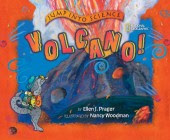
Jump into Science: Volcano! By Ellen J. Prager. Illus. by Nancy Woodman. 2001. 31p. National Geographic Society, (978-1-4263-0091-2). Gr. 4-6.
How do volcanoes erupt? What is lava and what happens when it cools? Where are the world's biggest volcanoes? Just stay cool—and let Volcano Vulcan, Dragon Explorer, take you around the hot-spots!


The Magic School Bus Blows its Top: A Book About Volcanoes! By Gail Herman. Illus. by Bob Ostrom. 1989. 40p. Scholastic Press, (978-0590407601). Gr. 2-5.
Cole and Degen have struck at the core once again to produce an exciting, attractive, and informative science book for young readers. This time, it's to the center of the earth. Surprises abound through each strata down to the very inner core where it is hot, hot, hot. The class collects rock samples before the bus is expelled from the earth's core in a volcanic eruption. A tongue-in-cheek section at the end discusses the real and fantasy aspects of the book.


Volcano-National Geographic Nature Library. By Catherine H. Howell. 2001. 60p. National Geographic Society, (0-7922-7580-2). Gr. 4-7.
Vivid book with good explanat
ions of what is a volcano? and where they occur. Amazing pictures of active and dormant volcanoes with discussions of what may be yet to come.


Volcano!: The 1980 Mount St. Helens Eruption. (Extreme Disasters That Changed America). By Gail B. Riley. 2006. 32p. Bearport Publishing Co., Inc., (978-1597160728). Gr. 4-6.
Story and pictures of Mount St. Helens prior to the eruption, during the eruption and what was left after the eruption. Extended discussion of the aftermath of the explosion.

Volcano Wakes Up! By Lisa W. Peters. Illus. by Steve Jenkins. 2010. 30p. Henry Holt and Company, LLC, (978-0-8050-8287-6). Gr. 3-6.
Book of poems illustrating a day from sunrise to moonrise on an imaginary Hawaiian volcano as told by the things on or near the volcano, such as ferns, roads, crickets and the sun and moon.


Volcanoes! By Anne Schreiber. 2008. 32p. National Geographic Children's Books,(978-1426302855). Gr. 3-5.
The cool story of volcanoes will intrigue kids and adults alike. Anne Schreiber’s narrative gives readers a little of the science, a little of the history, and a lot of the action. National Geographic photography fires the imagination on dramatic spreads alive with vivid images of lava, ash, molten rock, weird rocks, and steaming seawater.

Volcanoes: Witness to Disaster. By Judith B. Fradin and Dennis B. Fradin. 2007. 48p. National Geographic Society, (978-0-7922-5376-1). Gr. 5-7.
Informational text on different witness accounts of volcanoes, eye-opening photos and drawing of volcanic explosions in the past, and the damage caused by volcanoes.


Will it Blow?: Become a Volcano Detective at Mount St. Helens. By Elizabeth Rusch. Illus. by K.E. Lewis. 2007. 47p. Sasquatch Books, (978-1570615092). Gr. 5-7.
Outstanding book for kids where students use a series of clues to solve the mystery of whether Mount St. Helens will erupt again. It is illustrated in an eye-catching way for students and includes experiments to do with every clue. Students will love becoming a volcano adventurer.


V. Web Resources
Plate Tectonics.
Superior website related to book on plate tectonics. Site has amazing pictures and explanations of Pangaea, movement of the plates in the past and how the plates are still moving today. Details the key parts of earth's movement today, such as the ring of fire, the mid-atlantic ridge, hot spots and subduction zones.


The Magic School Bus: Blows its Top Books and Games.
This site is a fun romp through the inner workings of a volcano as described in the book noted above, "The Magic School Bus Blows its Top: A Book About Volcanoes!" Students get to navigate the magma from the magma chamber under a volcano to help the volcano blow its top. In following the path, the site discusses the layers of the earth. Once you have conquered the volcano, the site gives the history of volcanoes and other volcano factoids.

Volcano Explorer. Site from Discovery Kids that has students build a volcano and erupt a volcano. The type of volcano they create is based upon the viscosity and gas settings they input for the magma.

Can We Predict Volcano Eruptions? Website from Annenberg Media detailing how scientists predict when a volcano may erupt.

National Geographic-Volcanoes. Site with vivid videos and pictures of volcanoes in eruption and the aftermath. The before and after eruption photos of Mount St. Helens are worth viewing alone. Easy to navigate for kids and is definietly an attention-grabber!

VI. Assessment Resources
Assessment for the layers of the Earth. This is a short set of discussion questions designed to determine if students have grasped not only the layers of the earth, but what composes them as well.

Assessment for the layers of the earth and the movement of tectonic plates. These are discussions question regarding the layers of the earth and the movement of the tectonic plates from Pangaea to the present that will assess whether students have grasped the concept taught.

Assessment for how a volcano is created and volcano vocabulary. Good test of concepts taught in lessons 4, 5 and 7. This is the answer key.

Students do cross-section drawing of snackfood experiment. Assessment for Day 4 experiment with plate tectonics and snackfood.

Assessment for Volcanologist Emergency Day 10. At the end of the lesson plan for Volcanologist Emergency, there is are discussion questions and an assessment/rubric for the lesson.


Friday, October 7, 2011

Annotated Bib - Food Multiplication

Multiplication allows one to determine how many are in a total set by knowing how many equal groups there are and how many objects are in each set. Multiplication is a quicker and more efficient way of doing repeated addition. Multiplication is used in everyday situations particularly with food. Cooking, buying, ordering, and selling food all require multiplication. It is important to be able to multiply the amount of food ordered or the ingredients in a recipe by a particular amount in order to feed all those who intend to eat it. Students begin learning multiplication facts in third grade.

Books
The 512 Ants on Sullivan Street. By Carol Losi. Illus. by Patrick Merrell. 1997. 48p. Scholastic Inc., (0590308769). Gr. 3.
This book uses rhyming to tell the story of a girl who goes on a picnic, but ants are increasingly stealing her food. The amount of ants doubles each time which practices multiplying by twos and illustrates how quickly numbers increase when using multiplication.

Breakfast at Danny's Diner. By Judith Stamper. Illus. by Chris Demarest. 2003. 46p. Grosset & Dunlap, (9780448432663). Gr. 3-4.
This chapter book tells the story of Tony and Tina who spend the day helping their Uncle Danny at his dinner. They use multiplication in helping them set up the restaurant and cook the meals. They see that there is a lot of math and multiplication that goes into operating a restaurant. This book practices math facts up to twelve and shows the application of multiplication in an everyday situation.

Minnie's Diner. By Dayle Dodds. Illus. by John Manders. 2004. 40p. Candlewick Press, (9780763617363). Gr. 3.
This books tells the story of brothers who go to a diner and order food. Each consecutive brother orders twice the amount of food previously ordered which shows multiplication by twos. The drawings in the book are great and do a really nice job of showing the idea of doubling.

More M&M's Math. By Barbara McGrath. Illus. by Roger Glass. 1998. 32p. Charlesbridge, (9780881069938). Gr. 2-4.
This book counts M&Ms to practice addition, subtraction, multiplication, and division. The book shows all of the equations in both numeral form and lays the M&Ms out.

Too Many Cooks! By Andrea Buckless. Illus. by K.A. Jacobs. 2000. 32p. Scholastic Inc, (
9780439169660). Gr. 3.
Siblings Cara, Jay, and Marcos cook up a soup, but they can not remember the recipe. They try to re-create the soup by thinking up the ingredients and multiplying the quantities by how many people will eat it. The book is silly but uses multiplication and has a useful guide in the book for explaining the equations used in the story.

Web Sites
The Ants Go Marching
A great game for students to practice their multiplication facts. Students must answer the questions before the ants eat their food. It would be easy to pair with The 512 Ants on Sullivan Street because they have the same theme. Students can choose which facts they want to work on.

Mouse Pizza

Students practice multiplication facts by dragging pizza to the table with the correct product number. Students can also choose which facts they want to practice.

Baking Cookies
Information and a lesson plan about how teaching using multiplication with food or recipes is a good way to make multiplication more concrete. It explains about how to teach while baking chocolate chip cookies.

Recipes
A lesson plan that teaches why it is important to multiply ingredients.

Penguin Milkshakes

A game in which students must answer the correct multiplication fact in order to serve their customers and keep everyone happy

For Teachers
VA Standard of Learning
3.5 The student will recall multiplication facts through the twelves table, and the corresponding division facts.

Background Information from Curriculum Framework
  • Strategies to learn the multiplication facts through the twelves table include an understanding of multiples/skip counting, properties of zero and one as factors, pattern of nines, commutative property, and related facts
  • Creating real-life problems and solving them facilitates the connection between mathematics and everyday experiences (e.g., area problems)
  • Develop fluency with number combinations for multiplication and division
  • Understand that multiplication is repeated addition.

Sunday, October 2, 2011

Annotated Bib - Count Down 10 to 1

The following collection of books have been selected to aid teachers in helping students develop the understanding of counting backwards. The grade level focus are geared towards K -2. Each book was chosen for it's illustrations, versatility, and ease of use. The versatility stems from the ability to use these books for counting 10 to 1, as well as, cross curricular applications for Language Arts and Science make these a must have for any classroom library.

Countdown to Kindergarten, by Alison McGhee, 2002, 32 pages, Harcourt Children's Books. (978Ten days before kindergarten starts, a dark-haired girl wakes up in a panic. "I've heard from a first grader that they have a lot of rules there," she confides, locking eyes with the audience. "You have to know how to tie your shoes. By yourself." Days nine, eight, seven and so on bring various shoelace disasters. As the 10 days before school wind down, she worries that she will be labeled "Velcro Girl" and finds endless ways to cover the gap in her skills through the destruction of her shoes and/or laces. Bliss presents the heroine with large-eyed innocence and humorous details.0152025168). Grades K-2


Countdown to Fall, by Fran Hawk. Illus. by Sherry Neidigh, 2009, 32 pages,  Sylvan Dell Publishing. (978-1607180395) Grades K-2
An informational picture book, emphasizing on trees and animals. A wonderful  book for teaching students to countdown from 10 to 1. As the facts about trees  count down, the images represent the numbers 10 to 1, while corner insets  show the tree, spring and fall leaves, a seed, and occasionally the flower of the  specific tree pictured, such as birch, dogwood, oak, and maple. Children will be  drawn to examine the expressive images of animals and find additional ones  along the detailed border featuring close-ups of the tree's bark. This attention  to detail makes the book more than a simple counting or seasonal book.

Count to 10 and Back Again: San Diego Zoo, by J.R. Brent Ritchie. Photo. By San  Diego Zoo. 2004, 14 pages, Candy Cane Press. (978-0824965525) Grades K-2.
A creative book for counting down from 10 with the ability to flip the book over  and count up from 1 to 10.Each number is connected to a corresponding  number of animals. The photographs are courtesy of the San Diego Zoo and  sure to delight the curiosity of any child.


One Was Johnny Counting Book, by Maurice Sendak, 1991, 48 pages, Harper  Collins. (978-0064432511). Grades K-2
From the brilliant mind and creator of "Where the Wild Things Are", comes a  beautifully illustrated tale about a kooky little kid, and crazy animal friends.  Nine arrive, and to get back to his solitude, Johnny counts backwards to make  them leave. But what will happen if they refuse to leave? Read on and find out  for yourself.


Ten Pup's Up, by Marsha Wilson Chall. Illus .by Henry Cole . 2010, 32 pp, Margaret K. McElderry Books. (ISBN 1416979603) Grades K-2

This picture book is great for Kindergarteners learning to count from 1 to 10 and back down again. The story begins with one pup waking up to start his day, then one by one, his siblings awaken until all ten are running about both playful and mischievous. Beautiful illustrations fused with colorful text, coupled with number words, numerals, and pictorial representation for one-to-one correspondence make this a must have in your classroom library.


The following links are internet bases sources of FREE lessons and games that will help teachers plan and supplement their number sense lessons dealing with counting down from 10. Fortunately for us, some sites include a wealth of information and links to more FREE online help.

This lesson is outlined in detail for a series of engaging activities to help students with the concept of counting down from 10 to 1.

Ok, the game for this particular activity is a little rudimentary BUT it is more engaging than a worksheet and can compliment what the students have learned using concrete manipulatives. The site is full of free lessons and activities for PK - middle school.

A simple point and click activities that would be great for a newcomer to number sense. The game begins with 10 written numerically and the written word. On the next line is a box with minus 1 (-1). The student clicks on the minus one ant the ten on top is converted to nine. This is repeated until the student gets to one. To reinforce concepts, the teacher can use this activity by starting with any number between and including (10 through 2) and have the student predict what number will be next when you take away one.

www.abcya.com - counting fish
Here is a great activity for teaching K-1 students basic number sense by using one-to-one correspondence to relate an object set to the correct numeric value. I thought this activity could be enhanced by instructing the students to count down from the identified number (or from 10 to the identified number) as a way to assess understanding of concepts.

For Teachers:
Virginia SOL - K.4 The student will
a) count forward to 100 and backward from 10;
b) identify one more than a number and one less than a number
Background Information from the Curriculum Framework
  • Counting skills are essential components of the development of number ideas; however, they are only one of the indicators of the understanding of numbers.
  • Counting backward by rote lays the foundation for subtraction. Students should count backward beginning with 10, 9, 8,¼ through ¼3, 2, 1, 0.
  • Counting forward and backward leads to the development of counting on and counting back.