Showing posts with label solar system. Show all posts

Monday, December 5, 2011

Unit Resource Portfolio: The Solar System


With all the recent developments in our solar system, it can be difficult to keep up with the changes. This unit focuses on the most up-to-date information regarding the eight planets and five dwarf planets that exist in our solar system but also gives students an understanding that new discoveries and notions are being made every day. The below lessons give students the opportunity to look at the planets in our solar system, even the demoted dwarf planet of Pluto, and study aspects of each that are unique and interesting. This unit is extremely hands-on and gives students many opportunities to make predictions, observations, and conclusions about the solar system.


Virginia Standards of Learning 
SOL 4.7 The student will investigate and understand the organization of the solar system. Key concepts include:
a) the planets in the solar system;
b) the order of the planets in the solar system; and
c) the relative sizes of the planets.

SOL 4.8 The student will investigate and understand the relationships among Earth, the moon, and the sun. Key concepts include
c) the causes for the phases of the moon

Background Information:
- Our solar system is ancient. Early astronomers believed that Earth was the center of the universe and all other heavenly bodies orbited around Earth. We now know that our sun is the center of our solar system and eight planets, a handful of dwarf planets, 170 named moons, dust, gas, and thousands of asteroids and comets orbit around the sun.
- Our solar system is made up of eight planets: Mercury, Venus, Earth, Mars, Jupiter, Saturn, Uranus, and Neptune.
- Mercury, Venus, Earth, and Mars are considered terrestrial planets. Jupiter, Saturn, Uranus, and Neptune are called gas giants.
- Mercury is closest to the sun and is a small, heavily cratered planet. Mercury looks like our moon. Since Pluto’s reclassification from planet to dwarf planet, Mercury is now the smallest planet in our solar system.
- Venus is second from the sun. It is similar to Earth in size and mass, and has a permanent blanket of clouds that trap so much heat that the temperatures on the surface of Venus are hot enough to melt lead.
- Earth is third from the sun. Earth’s atmosphere, the liquid water found on Earth, and its distance from the sun, among many other factors, make Earth a haven for life.
- Mars is fourth from the sun. The atmosphere on Mars is thin and there is a vast network of canyons and riverbeds on the red planet. Scientists hypothesize that Mars once supported a wet, warm Earth-like climate.
- Jupiter is fifth from the sun. Jupiter is the largest planet in the solar system and is considered a gas giant. Jupiter has no solid surface.
-Saturn is sixth from the sun. Early scientists thought Saturn was the only planet with rings, but we now know that all four gas giants (Jupiter, Saturn, Uranus, and Neptune) have rings.
- Uranus is seventh from the sun. Uranus is a gas giant.
- Neptune is eighth from the sun. Neptune appears blue through telescopes and is a gas giant.
- The eight planets sorted by size from largest to smallest are: Jupiter, Saturn, Uranus, Neptune, Earth, Venus, Mars, and Mercury.
- Pluto is no longer included in the list of planets in our solar system due to its small size and irregular orbit. Many astronomers questioned whether Pluto should be grouped with worlds like Earth and Jupiter. In 2006, this debate led the International Astronomical Union (IAU), the recognized authority in naming heavenly objects, to formally reclassify Pluto. On August 24, 2006, Pluto's status was officially changed from planet to dwarf planet.
- A new distinct class of objects called "dwarf planets" was identified in 2006. It was agreed that "planets" and "dwarf planets" are two distinct classes of objects. The first members of the dwarf planet category are Ceres, Pluto and 2003 UB313, given the name Eris.
- A dwarf planet has not "cleared the neighborhood" around its orbit, which means it has not become gravitationally dominant and it shares its orbital space with other bodies of a similar size.
Earth completes one revolution around the sun every 365 ¼ days. The moon revolves around Earth about once every month.
- Due to its axial tilt, Earth experiences seasons during its revolution around the sun.
- The phases of the moon are caused by its position relative to Earth and the sun. The phases of the moon include the new, waxing crescent, first quarter, waxing gibbous, full, waning gibbous, last (third) quarter, and waning crescent.
- The sun is an average-sized yellow star, about 110 times the diameter of Earth. The sun is approximately 4.6 billion years old.
- Our moon is a small rocky satellite, having about one-quarter the diameter of Earth and one-eightieth its mass. It has extremes of temperature, virtually no atmosphere or life, and very little water.
- Our understanding of the solar system has changed from an Earth-centered model of Aristotle and Ptolemy to the sun-centered model of Copernicus and Galileo.

Important Vocabulary:
cosmic dust - small particles less than 1mm in size produced from asteroids and comets
crater - bowl-shaped hollow on the surface of a planet, moon, or asteroid formed by a rock collision
dwarf planet - celestial body with all the characteristics of a planet except it does not "clear the neighborhood" around its orbit
gas giant - planet mostly made up of gas, includes Jupiter, Saturn, Uranus, and Neptune
moon - a rock that orbits around a planet or asteroid
orbit - the path of an object around an object caused by the larger objects gravitational pull
satellite - an object held in orbit around a planet or moon by gravity such as the Moon
terrestrial planet - planet made of rock, includes Mercury, Venus, Earth, and Mars

Day 1 - The Solar System
Students will:
  • Learn about the thirteen planets in the solar system and the difference between the eight planets and the five dwarf planets. 
  • Create a solar system to scale of the eight planets. 
  • Simulate the theories of Aristotle, Ptolemy, Copernicus, and Kepler using the solar system mobile. 
On the first day of the unit, students will be introduced to the eight planets and five dwarf planets of the solar system. They will learn the difference between the two types of planets and then create a solar system to scale based on the eight planets. After watching a video on the astronomers who contributed to the discovery that the planets revolve in elliptical movements around the sun, they will use the solar system mobile to recreate the theories proposed by the four astronomers as talked about in the clip. Lastly, students will receive charts to record the phases of the moon for the next two weeks.

Day 2 -  Pluto & the Dwarf Planets 
Students will:
  • Compare and contrast the characteristics of planets and dwarf planets. 
  • Read about the discovery of Pluto and it’s reclassification to a dwarf planet in 2006. 
  • Create a blink comparator to understand how Clyde Tombaugh discovered Pluto. 
This lesson will focus on understanding the difference between a planet and a dwarf planet. Since future lessons will focus on each of the planets, this will be the students’ only opportunity to learn about the dwarf planets. We will start by creating a foldable that compares and contrasts planets and dwarf planets.
Then we will read selections from Pluto: From Planet to Dwarf by Elaine Landau to learn more about Pluto’s discovery in 1930 and subsequent reclassification in 2006. Lastly, we will create our own blink comparator out of simple items like a box and tracing paper so students understand the technique Clyde Tombaugh used to discover Pluto.

Day 3 - The Sun 
Students will:
  • Recall what they already know about the sun. 
  • Compare the size of the sun to the size of the planets surrounding it. 
This lesson will begin by creating a KWL chart about what students already know about the sun and what they would like to know more about. Next the class will go outside with the solar system mobile they created earlier and use a long string and some chalk to draw a 13’ circle on pavement to simulate the sun. The group will then compare the size of the ‘sun’ to the size of the planets on the mobile. Inside, the class will watch NASA’s Sun For Kids video and pair up to create a chart in their science notebooks that lists “why we can’t live on the sun” and “why we can’t live without the sun”. Students will use the video and background knowledge to answer these questions. After discussing the answers as a group, students will reread the questions posted in our KWL chart and try to answer them based on what they learned.

Day 4 - The Moon 
Students will:
  • Identify the differences between life on Earth and life on the Moon. 
  • Explore the landscape, size, age and makeup of the Moon. 
  • Analyze popular misconceptions and subsequent historical contributions in understanding the Moon. 
  • Examine the movement of the Earth around the Sun and the Moon around the Earth to create the phases of the Moon. 
The lesson will begin with a reading of If You Decide To Go To The Moon by Faith Mcnulty. The class will then use Google Earth to view the moon and discuss the lunar landscape and other characteristics of the moon. Next the class will discuss misconceptions about the moon and use Google Earth to prove why they are not true. Students will then watch the explanation of the phases of the moon from Wonderville and then take turns with the interactive portion at the end of the presentation to reinforce their knowledge. Next students will make an accordion foldable showing the eight phases of the moon.

At the end of the lesson students will do a 3-2-1 analysis in their journals and write three ways being on the moon is different than being on earth, two things people once believed about the moon that we know aren’t true, and one thing they’d still like to know about the moon.

Day 5 - Mercury & Venus
Students will:
  • Illustrate why Mercury and Venus are classified as terrestrial or rock planets. 
  • Demonstrate why Mercury’s day is longer than its year. 
  • Observe the greenhouse effect to understand Venus’s gaseous atmosphere. 
This lesson will begin with students making predictions in their science journals about two thermometers set in sunlight, one inside a covered jar and one in open air. They will hypothesize what will happen to the temperatures of each thermometer after sitting in the sun for the entire period. Then students will analyze pictures of Mercury and Venus as well as the class solar system mobile to make inferences about both planets. In their science journals, they will write about both planets' sizes in comparison to the other planets as well as their relative distance from the sun and why they are terrestrial planets. After a discussion on how Mercury’s day is longer than its year, the class will create a model of Mercury’s rotation using material such as a desk lamp, a ball, and clay to better understand it. Lastly, students will observe the thermometers from the beginning of class and make conclusions about why the temperature changes occurred. They will then make connections between the thermometer in the covered jar and the cloud blanket covering Venus to understand the greenhouse effect.

Day 6 - Earth 
Students will:
  • Compare the distance from the Sun, size, and makeup of Earth to those of other planets within our solar system. 
  • Outline the relationship between the Earth and the Sun regarding time and the seasons. 
  • Contrast the climates of various regions of Earth relative to the Sun. 
To begin the lesson, students will fill out the first two sections of a KWL chart handout regarding Earth. Next students will analyze pictures of Earth as well as the class solar system mobile to make inferences about the planet. In their science journals, they will write about Earth’s size in comparison to the other planets as well as its relative distance from the sun. The class will then do an experiment involving a flashlight to demonstrate the angles in which the sun hits either hemisphere during various seasons. After a discussion on the length of an Earth year, the class will use Google Earth to explore the various features of Earth including deserts, frozen tundras, and rainforests and relate their climates to their relationship with the sun. Lastly, students will volunteer some questions they asked in their KWL chart handouts and the group will discuss the answers to complete the charts.

Day 7 - Mars 
Students will:
  • Test for living cells in sand to examine how scientists test for life on Mars. 
  • Discover the characteristics of the atmosphere and terrain of Mars. 
  • Illustrate why Mars is classified as a terrestrial planet. 
To start the lesson, students will divide into small groups to start an experiment similar to how they test for life on Mars. They will make predictions about what might occur in three jars of sand and sugar water, one with salt added, one with baking powder added, and one with yeast added. Next students will analyze pictures of Mars as well as the class solar system mobile to make inferences about the planet. In their science journals, they will write about the size of Mars in comparison to the other planets as well as its relative distance from the sun. The class will then read Touchdown Mars! by Peggy Wethered and Ken Edgett and then write letters in their science journals from the perspective of a visitor on Mars and using the new things they learned about Mars from the book. Lastly, students will look at the three jars they prepared in the beginning of class and make observations about what happened within each. In the end, the class will conclude that the jar with yeast showed signs of life because the presence of living cells caused a slow but continuous reaction as the cells multiplied.

Day 8 - Jupiter & Saturn 
Students will:
  • Illustrate why Jupiter and Saturn are classified as gas giants. 
  • Create their own Jupiter storm to simulate the huge storm patterns and streams of gas moving at different speeds on Jupiter’s surface. 
  • Test predictions about Saturn’s density versus the density of the rest of the planets. 
The lesson will begin with students discussing the properties of a gas giant using the book Mighty Megaplanets: Jupiter & Saturn for clues. Then students will analyze pictures of Jupiter and Saturn as well as the class solar system mobile to make inferences about both planets. In their science journals, they will write about the sizes of Jupiter and Saturn in comparison to the other planets as well as their relative distances from the sun and and why they are both gas giants. Next the class will discuss the cloud patterns of Jupiter, including the Great Red Spot, and then simulate a storm on Jupiter by combining milk, food dye, and dishwashing liquid in a bowl. Then the class will divide into groups and do an experiment that asks, “Would Saturn float?” They will first make predictions about how a plastic ball and a marble will float in water and then test their theories. The class will conclude as a group that since Saturn has the lightest density of the planets and its density is lighter than water, it would float, unlike the rest of the planets which would sink.

Day 9 - Uranus & Neptune 
Students will:
  • Illustrate why Uranus and Neptune are classified as gas giants. 
  • Simulate the rings of Uranus to understand why we can’t see them from Earth. 
  • Demonstrate how Neptune was discovered via mathematical calculations rather than a telescope. 
As a review, students will do a think-pair-share to discuss the properties of gas giants. As a group, the class will discuss these properties and then students will analyze pictures of Uranus and Neptune as well as the class solar system mobile to make inferences about both planets. In their science journals, they will write about the sizes of Uranus and Neptune in comparison to the other planets as well as their relative distances from the sun and and why they are both gas giants. Next students will divide into groups to experiment with simulating light shining on the dust particles in Uranus’s rings. The teacher will light a candle, blow it out, and capture the smoke in an empty soda bottle and seal it. Next students will make predictions about where to hold the flashlight to see the smoke particles. Each group will then shine the flashlight at the bottle and then from behind and record which made the smoke particles more visible. The class will conclude that the particles (and thus the rings) are most easily seen when they are lit from behind (as they were in 1977 when Uranus passed in front of a distant star and the rings were discovered). Lastly the class will discuss the discovery of Neptune and do an experiment using materials such as a magnet and a paper clip to simulate how the pull of Neptune affected Uranus to prove Neptune’s existence.

Day 10 - Review 
Students will:
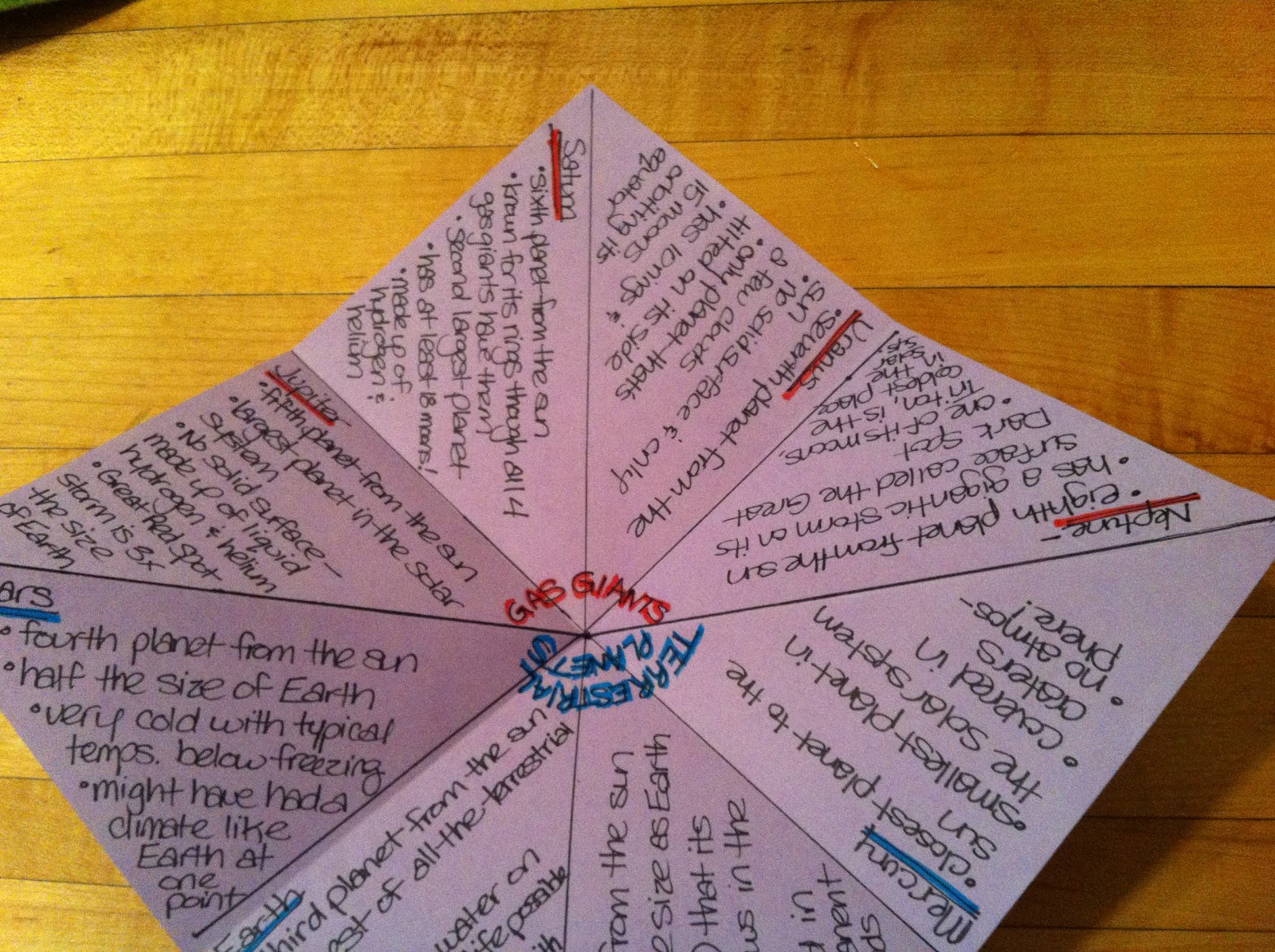
  • Create a foldable about the eight planets in the solar system and their unique characteristics. 
  • Review content from the Solar System unit.
The review will begin with students creating a diamond accordion foldable about the eight planets. The front will show the planets in order with some attention paid to scale as well as a mnemonic device to remember them in order.
Inside the foldable, students will divide the square into eight parts, four for the terrestrial planets and four for the gas giants. They will then use the entries in their science journals from the past two weeks to fill in information on each planet.

 The class will then divide in half and play a game of 'Solar System baseball' with the following rules:
1. If you answer a question correctly, you can move up a base.
2. If you answer incorrectly, it is an “out” (and the class answers as a whole).
3. Three “outs” and the inning is over and it’s the other team’s turn to “bat”.
4. The team with the most runs wins once all the questions have been answered.

Literature Connections

13 Planets: The Latest View of the Solar System by David A. Aguilar. Illus. by the author. 2011. 64p. National Geographic Children's Books. (978-1426307706). Gr. 2-5.
 The newest edition of this book includes the 8 planets and 5 dwarf planets that form our solar system. It’s a great introduction to the planets as it gives a brief overview of each planet and the sun, explains how the solar system formed, and briefly touches on the discovery of new solar systems orbiting distant stars. It’s enough information to get students acquainted with the planets before studying them more in depth as we’ll be doing later in the unit.


Far-Out Guide to the Sun
by Mary Kay Carson. 2010. 48p. Bailey Books. (978-1598451801). Gr. 2-5.
This book explores fascinating facts about the sun as well as mysteries still being researched today. It’s a comprehensive resource for learning about the sun because of the wide variety of topic it touches on, including the sun’s relationship with the earth, the age of the sun and its future, and the long journey research probe Solar Probe will begin in a few years when it departs Earth to research the sun.


How The Universe Works by Heather Couper and Nigel Henbest. 1994. 160p. Reader’s Digest. (978-0895775764). Gr. 4-6. 


This book is the source of 90% of the activities within this unit. It’s an amazingly creative resource for hands-on experiments kids can do to learn about the universe. The materials and prep work involved are never too complicated and experiments that require parents to help out are clearly noted. I was so excited to discover so many interesting experiments within this book and it’s a wonderful addition to any upper elementary science classroom.


If You Decide To Go To The Moon by Faith Mcnulty. Illus. by Steven Kellogg. 2005. 48p. Scholastic Press. (978-0590483599). Gr. 1-4.
In this imaginative book, readers go on a journey to the Moon and gain a perspective on how things differ up there. It’s a great way to help students understand the atmosphere and lack of gravity of the Moon as well as its unique landscape. The end of the fascinating journey gives students an idea of the importance of air and water, “Earth’s special blessings”. The book is a great way of helping students understand why we can’t live on the moon.


The Magic School Bus Lost In The Solar System by Joanna Cole. Illus. by Bruce Degen. 1992. 40p. Scholastic Press. (978-0590414296). Gr. 1-4.
Another adventure with Miss Frizzle, this is the story of the Magic School Bus’s journey through the solar system. This series of books is always a great way to get students imaginations going and help them see science class as more of an adventure than a task. This book even ends with the class making a mobile of their solar system discoveries which is also an activity in the unit. Students will love doing the same thing as the students in the story. The only caveat is it still includes Pluto as a planet but that would also be a great way to show students that for a long time everyone believed it was.


Mighty Megaplanets: Saturn & Jupiter by David Jefferis. Illus. by the author. 2008. 32p. Crabtree Publishing. (978-0778737537). Gr. 4-6.
This book is a great introduction to the gas giant planets. Though it focuses on Saturn and Jupiter, it goes into detail about the gas giants in general. Students will love learning about the rings of these gas giants, from the bold rings of Jupiter to the less visible rings of Saturn. Because it can be hard to grasp the idea of planets made up of mostly gas, the imagery and fun facts in this book make it a great resource for helping students understand the wonders of these two gas giants.


My Science Notebook: The Moon by Martine Podesto. Illus. by the author. 2009. 104p. Gareth Stevens Publishing. (978-0836892154). Gr. 3-5.
This book is a series of letters to ‘Dr. Brainy’, a scientist who knows all about the moon. The questions range from simple to more complex but Dr. Brainy never fails to give a thorough answer that’s easy to understand. This book would be a great addition to a KWL chart about the moon if students looked through it to see if Dr. Brainy answered any of the questions they came up with.


Nicolaus Copernicus: The Earth Is a Planet
by Dennis B. Fradin. Illus. by Cynthia Von Buhler. 2004. 32p. Mondo Pub. (978-1593360061). Gr. 3-6.
This book is a beautifully illustrated biography on Copernicus and how he contributed to astronomy with his idea that the planets rotate around the sun. Students will love the pictures and the elementary-level text will make it easy for them to understand Copernicus’s theories and notions.


Pluto: From Planet to Dwarf
by Elaine Landau. 2008. 48p. Children's Press. (978-0531147948). Gr. 2-5.
This helpful little book opens with two true or false statements, one of which is true and one of which is false. The false statement of course is that Pluto is a planet and the book goes on to explain the discovery of Pluto and its reclassification in 2006. The book is a great resource for helping students understand the difference between planets and dwarf planets.


Touchdown Mars!
by Peggy Wethered and Ken Edgett. Illus. by Michael Chesworth. 2000. 40p. Putnam Juvenile. (978-0399232145). Gr. 1-4.


This adventure book brings the readers on the long journey from Earth to Mars as an astronaut. Readers get to explore Mars from its canyons and volcanoes to its moons, learning facts about the red planet along the way. It’s an imaginative piece of literature to add to the classroom and even contains a Mars A-B-Cyclopedia at the end for student reference.


Web Resources
Classzone: Distances between planets in the solar system
This incredible simulation is a great way to help students visualize the vast distance between planets. Since the mobile we make in this unit has planets that are to scale but not distances to scale, this video is perfect for teaching that aspect. Students will be amazed at the vast distance between the outlying planets

Kids Astronomy: The Solar System
This interactive site gives users a chance to see the solar system in motion and to click on any part of it to learn more. It's a great way to help students visualize the different speeds at which the planets orbit the sun as well as the size of their orbits and the consequent varying lengths of their years. In 'visiting' all the various places in the solar system (even including comets and asteroid belts!), students get a full page of fascinating content on that topic that is both comprehensive and easy to understand.

Magic School Bus Space Chase
This quiz game coincides with the Magic School Bus book above. With each quiz question, the player follows Miss Frizzle around the solar system and answers questions along the way. The material is extremely relevant to the unit and its a fun way for students to review what they've learned.

NASA: StarChild Learning Center
StarChild is a great source for the most up-to-date information since it was created by NASA. Students can explore various topics on the solar system on both a beginner and intermediate level. The site has the option to have content pages read to you as well, which is great for younger students. In addition to information, there are games and activities and its easy to toggle back and forth between levels if users care to do so.

Wonderville: Phases of the Moon
This kid-friendly interactive activity gives students a quick lesson on the phases of the moon before it involves them in finding the phase of the moon that matches the moon's current position. I found a lot of simulations involving the phases of the moon to be somewhat confusing for children but this one makes it clear and also provides great visuals to really drive the point home.

Assessments
  1. Halfway through the unit, students will complete a Solar System Quiz that they will be graded on. (Answers: C, B, D, C, A B)
  2. At the end of the unit, students will complete the Solar System Unit Test. See also the
    Unit Test Answer Key
  3. Since the diamond accordion foldable created during the review was the product of notes taken in each student's science notebook over the unit, the foldable will be assessed as part of their grade. The rubric used to assess these foldables can be found here
  4. Each student's lunar chart will be collected and graded at the end of the unit. Students will be assessed on their ability to accurately describe which phases of the moon they observed and their diligence in observing and recording the moon's phases throughout the two week period. 
  5. Formative assessments will occur throughout the unit during all of the experiment activities that require predicting and testing. I will be looking for students who make thoughtful predictions, ask relevant questions before, during, and after the experiment, and can make educated conclusions by the end of it. 

Monday, November 28, 2011

Annotated Bib - The Solar System

The solar system is made up of all the planets that orbit our sun. We now know that our sun is the center of our solar system around eight planets, a handful of dwarf planets, 170 named moons, dust, gas, and thousands of asteroids and comets. Our solar system is made up of eight planets: Mercury, Venus, Earth, Mars, Jupiter, Saturn, Uranus, and Neptune.


Books


13 Planets: The Latest View of the Solar System. By David A. Aguilar. 2011. National Geographic Children's Books, (9781426307706). Gr. 3-6.

This book is great for several reasons. For one, it provides great factual information about our solar system. Secondly, it gives students a background about how we discovered our solar system. Written in 2011 this book provides up to date information about our solar system. For example, it explains to students how as of today, there are considered to be eight classical planets and five dwarf planets.

Our Solar System. By Seymour Simon. 1992. 64p. Harper Collins, (9780688099923). Gr. 3-6.

Using real pictures, this book gives students a great look into our solar system. Furthermore, this book offers great information about the planets, moons, asteroids, meteoroids, comets and the sun. With fifty amazing photographs and an easy-to-read text, this book great for introducing students to the solar system.

Planets: A Solar System Stickerbook. By Ellen Hasbrouck. Ilus. by Scott McDougall. 2001. 32p. Little Simon, (9780689844140). Gr. 2-4.

Although this is titled as "stickerbook", this book still provides wonderful facts about the different characteristics of our solar system. What makes this book really fun for students though, is that in the back there are numerous stickers of planets, comets, asteroids, etc. that students can use to recreate our solar system for themselves. This book offers a great way for students to manipulate the different planets in order.

Postcards from Pluto: A Tour of the Solar System. By Loreen Leedy. Illus. by the author. 1996. 28p. Holiday House, (9780823412372). Gr. 2-4.

This fun book gives students a tour of the solar system led by robot tour guide Dr. Quasar. The students on the tour however, are able to send postcards back home to earth to tell about their trip around the solar system. Each postcard is detailed with wonderful facts about the solar system. This book would be a great way to start off a lesson.

What's Out There?: A Book About Space. By Lynn Wilson. Illus. by Paige Billin Frye. 1993. 32p. Grosset & Dunlap, (9780448405179). Gr. 1-4.

This book answers simple questions students might have about our solar system. With colorful illustrations, this book highlights different aspects of our solar system in a fun way. This book is written in very simple text. However, this book would then be a great tool to use when differentiating instruction for weaker students.


Websites


Kid's Astronomy
This interactive site shows kids an accurate view of our solar system. Students are then able to click each of the planets to learn more information about that specific planet. Each subpage gives students background information about the names of the planets, the weight of each planet, the moons of each planet, as well as specific information unique to each planet.

Make A Solar System
This interactive sites allows students to make their own solar system using the planets, asteroids, and comets. Students are able to add each planet to the solar system one at a time. This site is a great way for students to see how the solar system works.

Planet Song
This page on National Geographic Kids has a great song about the planets written by a student! The song was then recorded and sung by recording artist Lisa Loeb! This fun song is a great way for students to learn the different planets.

Solar System
This page shows students real images of the planets, as well as the sun. Students are then able to click on each image to learn more about the planet or sun. This site is fun in that it gives students unique facts about each planet, rather than just the basic facts.

Space School Musical
This site provides nine different videos of a space school "hip-hopera" musical. The videos introduce students to the solar system through song and dance. The musical specifically follows a teenager named Hannah on a trip through the solar system. The great thing about this site, is that the musical is broken up into nine different videos so that students and teachers can chose which ones to watch.

For Teachers

SOL 4.7 The student will investigate and understand the organization of the solar system. Key concepts include
a) the planets in the solar system;
b) the order of the planets in the solar system; and
c) the relative sizes of the planets.


Background Information:
  • Our solar system is ancient. Early astronomers believed that the Earth was the center of the universe and all other heavenly bodies orbited around Earth. We now know that our sun is the center of our solar system and eight planets, a handful of dwarf planets, 170 named moons, dusts, gas, and thousands of asteroids and comets orbit around the sun.
  • Our solar system is made up of eight planets: Mercury, Venus, Earth, Mars, Jupiter, Saturn, Uranus, and Neptune.
  • The eight planets sorted by size from largest to smallest are: Jupiter, Saturn, Uranus, Neptune, Earth, Venus, Mars, and Mercury.
  • Pluto is no longer included in the list of planets in our solar system due to its small size and irregular orbit. Many astronomers questioned whether Pluto should be grouped with worlds like Earth and Jupiter. In 2006, this debate led the International Astronomical Union (IAU), the recognized authority in naming heavenly objects, to formally reclassify Pluto. On August 24, 2006, Pluto's status was officially changed from planet to dwarf planet.
  • A new distinct class of objects called "dwarf planets" was identified in 2006. It was agreed that "planets" and "dwarf planets" are two distinct classes of objects. The first members of the dwarf planet category are Ceres, Pluto and 2003 UB313, given the name Eris. More dwarf planets are expected to be announced by the IAU in the future.

Sunday, November 27, 2011

Annotated Bib - Planets

We have nine eight planets in our Solar System. These planets circle around the sun also called orbits. A lot of astronomy people like to think of the Solar System as having been made up of two parts. We have the Inner Solar System which has Mercury, Venus, Earth and Mars. These are closest to the sun and are called the terrestrial planets simply because the have very solid rocky surfaces. The Outer Solar System has Jupiter, Saturn, Uranus, and Neptune. Out past Neptune is Pluto which was a planet for many many years but has been unclassified as a planet now. These two systems are separated by the asteroid belt.


Books:


13 Planets: The Latest View of the Solar System. By David A. Aguilar. Illus. by the Author. 2011. 64 pg. National Geographic Children's Books. (978-1426307706). Gr. 3-6.

First, Pluto left. Then it came back, along with Ceres and Eris...and now Haumea and MakeMake, too! The recent actions of the International Astronomical Union have put every solar system book out of date. In response, National Geographic joins forces with David Aguilar of the Harvard Smithsonian Astronomical Observatory to revise our 2008 book—and to update young readers on the high-interest topic of space. Using simple text and spectacular photorealistic computer art by the author, this book profiles all 13 planets in their newly created categories—plus the sun, the Oort Cloud, comets, and other worlds being discovered. Back-of-the-book activities offer hands-on fun for budding astronomers.


Meet the Planets. By John McGranaghan. Illus. by Laurie Allen Klein. 2011. 32 pg. Sylvan Dell Publishing. (978-1607181330). Gr. K-5.

Soar into the Solar System to witness the first Favorite Planet Competition, emceed by none other than the former-ninth planet, now known as dwarf planet Pluto. The readers become the judges after the sun can t pick a favorite and the meteors leave for a shower. Who will the lucky winning planet be? Could it be speedy-messenger Mercury, light-on-his-feet Saturn, or smoking-hot Venus? Readers learn all about each planet as Pluto announces them with short, tongue-in-cheek facts. Children of all ages will spend hours searching the art for all the references to famous scientists and people of history, space technology, constellations, art, and classic literature.

Our Solar System. By Seymour Simon. Illus. Unknown. 2007. 72 pg. Harper Collins. (978-0061140082). Gr. 3-6.

Born almost 5 billion years ago at the edge of the Milky Way galaxy, our Solar System is a place filled with mystery and wonder. In the last fifty years, we have learned more than ever about the farthest reaches of our world. With dramatic full-color photographs and spacecraft images, Our Solar System takes young readers on a fascinating tour of the sun, the eight planets, and their moons, plus asteroids, comets, and meteoroids. Award-winning science writer Seymour Simon has teamed up with the Smithsonian Institution on

this new, updated edition of his much admired book about the vast and mystifying part of the universe that we live in.


The Planets 101. By Brad M. Epstein. Illus. Unknown. 2010. 20 pg. Michaelson Entertainment. (978-1607300113). Gr. All.

800 degrees...a day that is longer than the year...a 25,000 mile-wide storm...so light the entire planet would float...1,000 mile per hour winds...these are just a few of the cool facts young explorers will learn as the solar system unfolds before their eyes. The Planets 101 will amaze young and old with unbelievable photos and facts, presented in a unique, patent pending, panoramic fold format that provides a panoramic view of the entire solar system. The Planets 101 is designed for families to share: Young children will enjoy counting the planets, stunning photos and panoramic unfolding of the solar system. Older children and adults will enjoy interesting facts, the best photos from NASA and scale representations of the solar system, all presented in a unique format. Of course, there is also a special place for a photo of every young explorer!


What's Out There?: A Book about Space. By Lynn Wilson. Illus. by Paige Billin-Frye. 1993. 32 pg. Grosset & Dunlap. (978-0448405179). Gr K-5.

Oldie but Goodie! What is the sun made of? What causes night and day? Why does the moon change shape? Colorful collage illustrations and an easy-to-understand text bring planets, stars, comets, and the wondrous things out there in space right down to earth in a simple introduction to the solar system for young armchair astronauts. Full color.


Websites:


Astronomy For Kids.

A very, very simple straight to the point resource for kids. It lists all eight planets and each one is linked to a page of easy to read facts.


BrainPOP.

Ready to be schooled in solar system coolness? In this BrainPOP movie, Tim and Moby take you back to the birth of our home in space and give you a virtual tour of our galactic neighborhood! You’ll find out how long ago the solar system took its first baby steps, as well as the process by which the sun and planets actually formed. Find out about the two different categories of planet in our solar system, and meet each of the individual planets--plus other solar system bodies like dwarf planets and asteroids! It’s a whole system of fun!


Discovery for Kids: Space.

Games, facts, stories, pictures all in one place! A wonderful website for kids to explore our Solar System. Easy to use. Links for teachers to take tid bits from!


The Eight Planets Just for Kids.

This website is suitable for the younger audience (upper elementary grades). The website is a very comprehensive information site featuring the planets of our solar system (related items included). They have created a simpler, more focused website, eliminating the more advanced concepts, emphasizing the more basic concepts, and giving it a more 'kid-friendly' look-and-feel. Teachers are welcome and encouraged to e-mail the creator with feedback regarding suitability and/or improvements to the page.


Planets for Kids.

Created by a curious nine year old and his father, this website is a free Astronomy Network for kids. It has tabs for every planet and a wealth of information. Easy to use and specifically designed for the child in mind.


For Teachers


Virginia Standards of Learning

SOL 4.7 The student will investigate and understand the organization of the solar system. Key concepts include:

a)the planets in the solar system

b)the order of the planets in the solar system; and

c) the relative sizes of the planets


Background Information:

•The Earth completes one revolution around the sun every 365 days. The moon revolves around the Earth about once every month.

•Due to its axial tilt, the Earth experiences seasons during its revolution around the sun.

•The phases of the moon are caused by its position relative to the Earth and the sun. The phases of the moon include the new, waxing crescent, first quarter, waxing gibbous, full, waning gibbous, last quarter, and waning crescent.

•The sun is an average-sized yellow star, about 110 times the diameter of the Earth. The sun is approximately 4.6 billion years old.

•Our moon is a small rocky satellite, having about one- quarter the diameter of the Earth and one-eightieth its mass. It has extremes of temperature, virtually no atmosphere, no water, and no life.

•The Earth is one of nine planets that revolve around the sun and comprise the solar system. The Earth, the third planet from the sun, is one of the four rocky inner planets. It is about 150 million kilometers from the sun. (The emphasis is placed on the Earth, rather than the other planets.)

Wednesday, November 2, 2011

Annotated Bib - Solar System

"We are all connected to each other biologically to the earth chemically to the rest of the universe atomically"
-Degrasse Tyson.

This post is all about the solar system and its planets. Below is a great list of books to use in order to spark your child's mind with wonder. We are all connected in the solar system and the root to many answers mankind seeks is out there. Lets get our children interested in the planets early on so, that they can one day explore the unknown that is the almighty universes.

Books
The Earth Book. By Todd Parr. 2010. 40 p. Little, Brown Books for Young Readers, (978-0316042659) Gr. 4-6.
This is a great book that talks about things we can do to take care of the earth. While this book teaches children about the basics of the book it has a strong message behind it. It teaches them to recycle and that every action no matter how small is a small step towards persevering the earth. This is a good warm up to teaching about the solar system as well because it starts with the basics. This is earth, it has a moon, People live on earth, but we must take care of the earth because its the only planet that we know of that harbors life. This is a good starter book when you want to break the ice into the solar system and how earth is important to humans talk.

Exploring the Solar System: A History with 22 Activities for Kids. By Mary Kay Carson. 2008. 176 p. Chicago Review Press, (978-1556527159) Gr. 5-6.
Can we say COOL! This paperback book introduces kids to our friendly solar system and its planets. It even traces the history of humans exploration into space. This book even comes with cool activities for you and your child to do. This is a great bonding book for you and your children to both learn about space together. It has plenty of pictures and is an easy read, but still packed with plenty of information! Get excited!

Comets, Stars, the Moon, and Mars: Space Poems and Paintings. By Douglas Florian. 2007. 56 p. Harcourt Children's Books, (978-0152053727) Gr. 3-6.
This book looks at the astronomy through the words of poetry. Each poem is a scientific look at a different part of our solar system. This is a great ice-breaking book to get kids thinking about the solar system. This book also includes great drawings and real pieces of art to look at in regards to the solar system. Its a beautiful book. Once again a great book to get them thinking about what space looks like.

13 Planets: The Latest View of the Solar System. by David A. Aguilar. 2011. 64 p. National Geographic Children's Books, (9781426307706) Gr 5-6.
This book looks at all 13 planets that's right I said 13 in their newly created categories. This book takes a photo realistic computer art look to profile each planet. This book profiles the recent actions of the International Astronomical Union, and in the regards to this book they have just put every other solar system book out of date. This is a great book for an up to date look at the way we observe the space around us.

Comets, Meteors, and Asteroids. By Seymour Simon. 1998. 32 p. Harper Collins, (978-0688158439) Gr 3-5.
This is a great kids book for a young audience and has plenty of color photos and it talks about the solar system and all its great wonders. This features wonderful basic information about comets, meteors, and asteroids that is great for introducing these concepts to kids. Most young readers are fascinated by the idea of a shooting star and this book covers that and so much more. It's a great read!

Websites
We Are All Connected.
This is a great video that talks about the universe and what its made of. This video is a blend of audio clips from icons in the science community. This is a great video to play at the beginning of a lesson plan to get kids thinking about what they are about to learn about.

Distance Between Planets.
This is a wonderful video that Bill Nye features a talk about the distance between planets. This is great when talking to kids about the solar system because all kids love Bill Nye. Its also very engaging for young viewers and educational when trying to explain the distance between planets in space.

Kids Astronomy.
This site is called kids astronomy and let me say it is AWESOME. The cite breaks down interactive games by planet. This is a great way for kids to interact and learn about the solar system and its planets through a fun series of games.

Kids NASA
This website is from NASA and is a great interactive and informative website for kids. They designed it specifically for kids who are learning about the solar system. They also included some pretty cool links as well. Kids will love these interactive games also included in the website.

Moon Facts
This is a great website that is all about the moons for kids. It includes plenty of fun facts and information. A good foundation for basic information.

Symphony of Science
This is a website that mixes audio from great icons from the science community mixed over music to teach different ideas and concepts. Its a fun website!

For Teachers
SOL: 6.8 The student will investigate and understand the organization of the solar system and the
relationships among the various bodies that comprise it. Key concepts include,
a) the sun, moon, Earth, other planets and their moons, meteors, asteroids, and comets.
The concepts developed in this standard include the following:
• The solar system consists of the sun, moon, Earth, other planets and their moons, meteors, asteroids, and comets. Each body has its own characteristics and features.
• The distance between planets and sizes of the planets varies greatly. The outer, ìgasî planets are very large, and the four inner planets are comparatively small and rocky.
• Gravity is a force that keeps the planets in motion around the sun. Gravity acts everywhere in the universe.
• Planets revolve around the sun, and moons revolve around planets. A planet rotates upon an axis.
• As the Earth rotates, different sides of the Earth face toward or away from the sun, thus causing day and night, respectively.
• The phases of the moon are caused by its position relative to the Earth and sun.
• The Earth is a rocky planet, extensively covered with large oceans of liquid water and having frozen ice caps in its polar regions. The Earth has a protective atmosphere consisting predominantly of nitrogen and oxygen and has a magnetic field. The atmosphere and the magnetic field help shield the Earthís surface from harmful solar radiation. Scientific evidence indicates that the Earth is about 4.5 billion years old.
Seasons are caused by the tilt of the Earth on its axis and, thus, the angle at which sunlight strikes the surface of the Earth during its annual revolution around the sun.
• Tides are the result of the gravitational pull of the moon and sun on the surface waters of the Earth.
• The ideas of Ptolemy, Aristotle, Copernicus, and Galileo contributed to the development of our understanding of the solar system.
• With the development of new technology over the last half- century, our knowledge of the solar system has increased substantially.
In order to meet this standard, it is expected that students should be able to
• describe the nine planets and their relative positions from the sun.
• design and interpret a scale model of the solar system. (A scale model may be a physical representation of an object or concept. It can also be a mathematical representation that uses factors such as ratios, proportions, and percentages.)
• explain the role of gravity in the solar system.
• compare and contrast revolution and rotation and apply these terms to the relative movements of planets and moons their moons.
• model and describe how day and night and the phases of the moon occur.
• model and describe how the Earthís axial tilt and its annual orbit around the sun cause the seasons.
• describe the unique characteristics of planet Earth. • discuss the relationship between the gravitational pull of
the moon and the cycle of tides.
• compare and contrast the ideas of Ptolemy, Aristotle, Copernicus, and Galileo related to the solar system.
create and interpret a timeline highlighting the advancements in solar system exploration over the past half century. This should include information on the first modern rockets, artificial satellites, orbital missions, missions to the moon, Mars robotic explorers, and exploration of the outer planets.

Wednesday, September 28, 2011

Annotated Bib - The Solar System

There are a lot of books available for children about the solar system in both the picture book and nonfiction sections of the library. Fourth graders are at an age where they still need and appreciate small and sometimes fictional books about scientific concepts. The picture books are good because they explain the information simply and encourage children to use their imaginations about science concepts. The nonfiction books contain more accurate illustrations and actual pictures of the planets and ideas that are described.

Books
Destination: Space By Seymour Simon. (2006). 32p. Collins. 9780060877231. Gr. 3.
This book has big photographs of different features of the solar system, such as nebulas, supernovas, and planets. Beside each photograph is a detailed description of the photograph. Although the reading level would be about grade 3, each page contains a lot of interesting facts that older children would like, as well.


Exploring the Solar System: A History with 22 Activities. By Mary Kay Carson. (2008). 176p. Chicago Review Press, 9781556527159. Gr.4-5.
This book is full of facts, history, and activities relating to the solar system. There is extensive information about each planet. Information about famous astronomers is provided as well. Predictions for future discoveries and explorations are also made.


By Monica Grady. Illus. by Lucia deLeiris. (2007). 32p. Francis Lincoln Children's Books, 9781845075705. Gr. 3-4.
This book gives simple yet detailed information about many different parts of the solar system. The illustrations are good. The descriptions include explanations of where each planet, moon, or star comes from. There is a glossary in the back.


By David Aguilar. (2011). 64p. National Geographic Children's Books, 9781426307706. 4-5 Gr.
This book provides up-to-date information about the thirteen planets. There are enhanced photographs on every page. There are activities in the back. This book contains simple text, but would be applicable for fourth-fifth grade just as well.


The Magic School Bus: Lost in the Solar System By Joanna Cole. Illus. by Bruce Degen. (1992). 40p. Scholastic Press, 9780590414296. Gr. 3-4.
This book is an entertaining way to get kids interested in studying the solar system. There is humor, conversation bubbles, facts, and an interesting story. There are also many different illustrations on each page. Fourth graders may still find this book useful.


Websites

For Teachers
This website provides detailed information about different topics relating to the solar system. Meteors, the Moon, stars, comets, planets, and the Sun are discussed. The size, temperature, and other characteristics are mentioned.

This website provides information on topics relating to the solar system as well as news articles and information about past and future space exploration. There are resources available for teachers and kids.

This website gives lesson plan ideas and game ideas for teaching the about the solar system. It also gives recommendations for websites and books that teachers and kids can use.

For Kids
Kids' Astronomy
This website has icons for the planets and their moons. There is an interactive replica of the planets and how they rotate on their axes. There are games, also.
This website would be useful for teachers and kids who are interested in exploring history of space exploration further. There are detailed descriptions and pictures of many past U.S. vessels which were launched into space. There are current news articles about space exploration.

For Teachers
Virginia Standard of Learning
SOL 4.7 The student will investigate and understand the organization of the solar system. Key concepts include: 
(a) planets in the solar system.

Background Information from Curriculum Framework

Look under 4.7: I could not paste the material.

Annotated Bib - The Solar System

The Solar System consists of the sun, planets, their moons, and other bodies, such as meteors and comets that orbit the sun. The planets in order from the sun are Mercury, Venus, Earth, Mars, Jupiter, Saturn, Uranus and Neptune. The sun is by far the biggest. The planets are held in orbit around the sun by a force called gravity. We cannot see the planets with our naked eyes, but with telescopes. The planets have dramatically different sizes and atmospheres.

Books
Exploring the Planets! By Bonnie Sachello-Sawyer. 2000. 80 p. Scholastic, (9780590685733). Gr. 3-5.
This activity book includes information about the planets plus activities such as reproducible games, mini-books, a read-aloud play, simple science experiments, art projects and even a planet fact poster. Explores all 9 planets (including Pluto).

Exploring the Solar System: A History with 22 Activities. By Mary Kay Carson. 2008. 176 p. Chicago Review Press (9781556527159).  Gr. 3-5. 
This book not only introduces the solar system, but also the history of human exploration in it. Each chapter has sidebars containing biographical sketches of noteworthy astronomers and other scientists, additional information on subjects such as telescopes, and activities relating to ideas of that time. Does not include Pluto. 

Our Solar System. By Seymour Simon. 2007. 72 p. Collins; Updated Edition (9780061140082). Gr. 3-5.
This book provides readers with a tour of the sun, the eight planets and their moons, asteroids, meteoroids and comets. The award winning Seymour Simon has teamed up with the Smithsonian Institution on this new and updated version of the universe. Does not consider Pluto a planet.

The Planets in Our Solar System. By Franklyn M. Branley. Illus. by Kevin O'Malley. 1998. 32 p. Collins (9780064451789). Gr. 1-2.
Simple points are made precisely and succinctly by Branley so as to avoid distracting commentary and dialogue. O'Malley provides colorful illustrations that go along with the informative facts that are easy for early elementary students to understand. The author uniquely presents the planets in groups based on heavenly bodies, temperatures, size and other comparative terms as opposed to listing the planets in the order they come. The book has additional websites and hands on activities. Includes Pluto.

The Solar System (True Books: Space). By Howard K. Trammel. 2010. 48 p. Children's Press, (9780531228050). Gr. 3-5.
This series explores the solar system, galaxies, stars, and other objects in space. Other books in the series include True Books on Earth, Saturn and Mercury. This book is full of catchy photographs and panoramas of outer space. The chapters are full of fascinating details and move from the inner to the outer planets. Pluto is not included.

There's No Place Like Space: All About Our Solar System. By Tish Rabe. Illus. by Aristides Ruiz. 1999. 48 p. Random House Books for Young Readers, (9780679891154). Gr. 1-2.
Fans of Dr. Seuss's favorite cat in the hat will love this book. Readers will learn about the solar system through rhymes and cartoon like illustrations similar to the originals. The familiar format and entertaining text are very appealing to early elementary readers. Includes Pluto.

Websites
This website allows children to click on any of the orbiting planets to get additional information such as how much you would way on a given planet. The website provides additional tabs to learn about asteroids, comets and each of the planet's moons.

Planet Facts
Very organized page of all of the nine planets (including Pluto), with images and additional information when clicking on a particular planet.

Click any planet on this website to get additional information; additional links to view pictures and video clips. This site looks like it could be useful for a fourth or fifth grader who needs to find some research for a project on the solar system.

The education section under the NASA website. Teachers can go to this website to gain more in depth information about the solar system. Different tabs allow the teacher to learn about explorations, planetary processes and weather, the early solar system, and astrology. This particular link takes teachers to the What We Explore: Education Activities link. From there the teacher can choose from a variety of PDF downloads for a number of activities exploring motion, organization, the study of the sun, the inner planets, and much more.

The Earth in Space
Directions for the teacher to guide a virtual exploration of which planet has the largest volcano in our solar system. The activity instructions include vocabulary, building background, guided exploration, review/assessment, and even extended activities to reach all learners. By exploring which planet has the biggest volcano, the visitor goes through information and facts about all of the nine planets (including Pluto).

For Teachers
Virginia Standards of Learning
4.7 The student will investigate and understand the organization of the solar system. Key concepts include
a)    the planets in the solar system;
b)    the order of the planets in the solar system; and
c)    the relative sizes of the planets.

Background Information from Curriculum Framework
  • Our solar system is ancient. Early astronomers believed that Earth was the center of the universe and all other heavenly bodies orbited around Earth. We now know that our sun is the center of our solar system and eight planets, a handful of dwarf planets, 170 named moons, dust, gas, and thousands of asteroids and comets orbit around the sun. Our solar system is made up of eight planets: Mercury, Venus, Earth, Mars, Jupiter, Saturn, Uranus, and Neptune.
  • Mercury, Venus, Earth, and Mars are considered terrestrial planets. Jupiter, Saturn, Uranus, and Neptune are called gas giants.
  • Mercury is closest to the sun and is a small, heavily cratered planet. Mercury looks like our moon. Since Pluto’s reclassification from planet to dwarf planet, Mercury is now the smallest planet in our solar system.
  • Venus is second from the sun. It is similar to Earth in size and mass, and has a permanent blanket of clouds that trap so much heat that the temperatures on the surface of Venus are hot enough to melt lead.
  • Earth is third from the sun. Earth’s atmosphere, the liquid water found on Earth, and its distance from the sun, among many other factors, make Earth a haven for life.
  • Mars is fourth from the sun. The atmosphere on Mars is thin and there is a vast network of canyons and riverbeds on the red planet. Scientists hypothesize that Mars once supported a wet, warm Earth-like climate.
  • Jupiter is fifth from the sun. Jupiter is the largest planet in the solar system and is considered a gas giant. Jupiter has no solid surface.
  • Saturn is sixth from the sun. Early scientists thought Saturn was the only planet with rings, but we now know that all four gas giants (Jupiter, Saturn, Uranus, and Neptune) have rings.
  • Uranus is seventh from the sun. Uranus is a gas giant.
  • Neptune is eighth from the sun. Neptune appears blue through telescopes and is a gas giant.
  • The eight planets sorted by size from largest to smallest are: Jupiter, Saturn, Uranus, Neptune, Earth, Venus, Mars, and Mercury.
  • Pluto is no longer included in the list of planets in our solar system due to its small size and irregular orbit. Many astronomers questioned whether Pluto should be grouped with worlds like Earth and Jupiter. In 2006, this debate led the International Astronomical Union (IAU), the recognized authority in naming heavenly objects, to formally reclassify Pluto. On August 24, 2006, Pluto's status was officially changed from planet to dwarf planet.
  • A new distinct class of objects called "dwarf planets" was identified in 2006. It was agreed that "planets" and "dwarf planets" are two distinct classes of objects. The first members of the dwarf planet category are Ceres, Pluto and 2003 UB313, given the name Eris. More dwarf planets are expected to be announced by the IAU in the future.
  • What differentiates a dwarf planet from a planet? For the most part, they are identical, but there is one key difference: A dwarf planet has not "cleared the neighborhood" around its orbit, which means it has not become gravitationally dominant and it shares its orbital space with other bodies of a similar size.
  • Pluto is smaller than seven of the moons in our solar system and cannot be seen without a telescope.